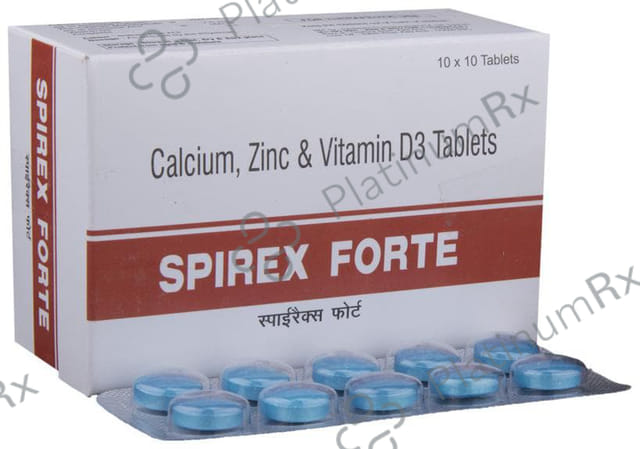
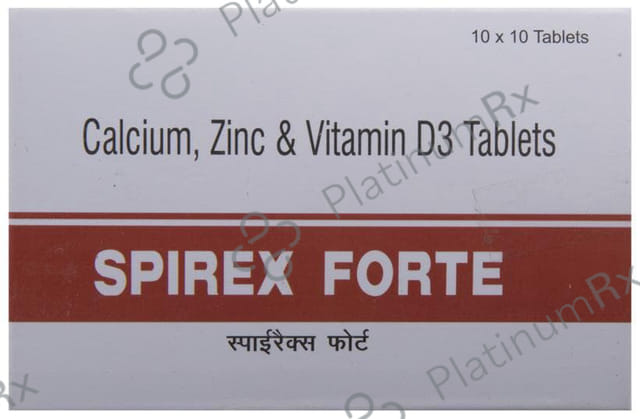
Spirex Forte Tablet

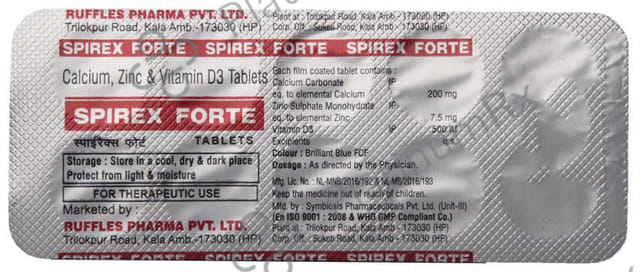
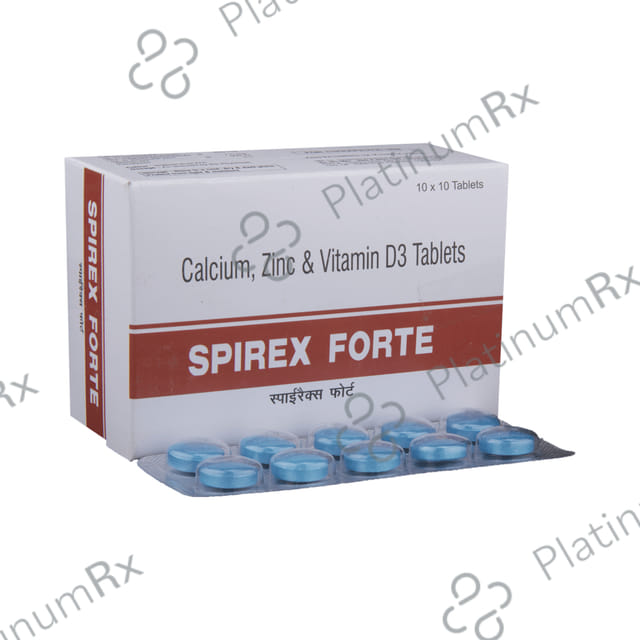
Spirex Forte Tablet is a widely used supplement combination for bone health and general wellness. It has a combination of calcium, the principal mineral in bone, and Vitamin D3 (Cholecalciferol), which enables intestinal calcium absorption and supports bone mineralisation. It further has zinc, which is an essential trace mineral involved in bone matrix synthesis, immunity, and tissue repair. Spirex Forte Tablet is used to prevent and manage calcium and vitamin D deficiency, support bone health across the lifespan, and meet increased needs in pregnancy, lactation, and ageing.
Written by: Syed Jommy Abbas, B. Pharma
Reviewed by: Dr. Rohit Kolhe, MBBS
Last updated on: 02-06-2026
FDA & GMP Certified
Long Expiry (>8 Months)
15 Days Easy Returns
General Information
Have a question?

Genuine Medicine
Pay On Delivery
Secure Payment

LegitScript Certified Online Pharmacy

More About Spirex Forte Tablet
Quick Summary
Spirex Forte Tablet is a widely used supplement combination for bone health and general wellness. It has a combination of calcium, the principal mineral in bone, and Vitamin D3 (Cholecalciferol), which enables intestinal calcium absorption and supports bone mineralisation. It further has zinc, which is an essential trace mineral involved in bone matrix synthesis, immunity, and tissue repair. Spirex Forte Tablet is used to prevent and manage calcium and vitamin D deficiency, support bone health across the lifespan, and meet increased needs in pregnancy, lactation, and ageing.
Detailed Description
Calcium is the most abundant mineral in the body and the structural backbone of bones and teeth. Further, it is also essential for nerve transmission, muscle contraction, clotting, and hormone secretion. Hence, inadequate intake forces the body to draw on skeletal calcium, gradually weakening bone.
Vitamin D3 is the form synthesised in skin on sunlight exposure and obtained from animal foods. It is converted in the liver to 25-hydroxyvitamin D and then in the kidney to its active form, calcitriol, which promotes calcium absorption from the gut and reabsorption in the kidney. Without enough vitamin D, even adequate calcium intake fails to help promote strong bones. Zinc is involved in over 300 enzymatic reactions, including bone matrix protein synthesis, osteoblast differentiation, and collagen formation, and supports immunity and wound healing. Zinc deficiency is common in vegetarians, older adults, pregnant and lactating women, and those with malabsorption. Together, these nutrients address the structural and regulatory needs of healthy bone.
Uses of Spirex Forte Tablet
- To prevent and manage calcium and vitamin D deficiency.
- To help support nutritional therapy in osteoporosis (weak & brittle bones) and osteopenia (loss of bone density).
- For postmenopausal bone health alongside lifestyle and prescribed treatment.
- To meet increased calcium, vitamin D, and zinc requirements during pregnancy and lactation.
- For the growth and development support in children and adolescents (under medical guidance).
- For recovery support after fractures or orthopaedic surgery.
Benefits of Spirex Forte Tablet
- Lower the risk of fractures in those with osteoporosis and maintain bone strength.
- Vitamin D3 improves calcium absorption, as calcium supplementation alone may prove ineffective.
- Zinc contributes to bone matrix formation, immunity, and wound healing, supporting convalescence.
- Convenient single-dose delivery of three commonly co-deficient micronutrients.
- Generally well tolerated, with long clinical experience behind it.
Side Effects of Spirex Forte Tablet
Common
- Constipation, bloating, gas, and/or mild stomach upset
- Nausea (commonly experienced if taken on an empty stomach)
- Metallic taste
Uncommon
- Loss of appetite
- Headache
- Loose stools
- Dry mouth (xerostomia)
Serious side effects requiring immediate attention
- Hypercalcaemia (high calcium levels in blood), seen in people who take either high doses or use it for prolonged periods
- Vitamin D toxicity from chronic high-dose use
- Kidney stones in those at risk of developing or with a history
- Severe allergic reactions
Directions for Use
Take Spirex Forte Tablet orally once or twice daily, with or just after a meal, as it helps improve absorption and reduces the incidence of stomach upset. Vitamin D3 absorbs better with a meal containing some fat. Single calcium doses of 500 mg or less are absorbed more efficiently than larger boluses, so splitting daily intake across two meals is helpful when total daily calcium is high. Maintain hydration and combine with a balanced diet and weight-bearing activity.
How it works
Your body requires a steady supply of calcium and a proper balance of hormones that regulate the movement of calcium between the gut, blood, and bones, to ensure your bone health is optimal. Calcium provides the raw mineral that bone-building cells (osteoblasts) use to form hydroxyapatite, the hard crystalline structure that gives bones their strength. It is absorbed in the small intestine through two routes: an active pathway that depends on vitamin D, and a passive route where calcium slips between intestinal cells on its own.
Vitamin D3 is first converted in the liver to 25-hydroxyvitamin D, and then in the kidney to its active form, calcitriol. Calcitriol binds to the vitamin D receptor in intestinal cells, switching on calcium-binding proteins (such as calbindin) and calcium channels that significantly boost active calcium absorption. It also helps the kidneys reabsorb calcium, and works together with parathyroid hormone to release calcium from bone when blood calcium levels drop.
Zinc plays both a structural and an enzymatic role in bone. It is essential for the activity of alkaline phosphatase (an enzyme involved in bone mineralisation), supports the growth and maturation of osteoblasts (bone-building cells), and aids collagen synthesis, which forms the framework of bone. Zinc also slows down osteoclast (bone-breaking cell) activity and supports immunity and wound healing, both of which are important for fracture and surgical recovery.
Safety Advice for Spirex Forte Tablet

Allergy
Unsafe
Avoid in known hypersensitivity to any component or excipient.

Breastfeeding
Safe
At recommended doses, calcium, vitamin D3, and zinc are considered safe and often beneficial. Avoid mega-doses.

Pregnancy
Safe
Commonly prescribed during pregnancy; use as advised.

Driving
Safe
No known effect on alertness or driving.

Alcohol
Caution
Heavy intake reduces calcium and vitamin D absorption and worsens bone health.

Liver
Caution
Severe liver disease can impair vitamin D activation. Dosing may need adjustment.

Kidney
Caution
In CKD, supplementation must be carefully tailored due to the risk of hypercalcaemia and vascular calcification.

Children
Caution
Use only as prescribed, as paediatric doses differ from adult doses.

Elderly patients
Safe
Often beneficial due to reduced sun exposure, intake, and absorption.
Drug-Food Interaction
- High-oxalate foods (spinach, rhubarb) (CAUTION): May reduce calcium absorption.
- Bran and high-phytate foods (CAUTION): May reduce calcium and zinc absorption.
- Caffeine and alcohol (CAUTION): Excess increases urinary calcium loss.
- High-fibre diets (CAUTION): May reduce zinc absorption.
- Foods with healthy fats (BENEFICIAL): Helps support vitamin D3 absorption.
Interactions with Other Drugs
- Levothyroxine (SEVERE): Calcium and zinc reduce absorption. Separate the medicines by at least 4 hours.
- Tetracyclines and fluoroquinolones (SEVERE): Calcium and zinc bind these antibiotics, reducing their efficiency. Separate the medicines by 2 to 4 hours.
- Bisphosphonates (SEVERE): Calcium reduces bisphosphonate absorption. It is advised to take bisphosphonate first thing and supplement at least 2 hours later.
- Iron supplements (CAUTION): Calcium and zinc compete with iron, reducing the amount of iron absorbed in the body. Separate the two by 2 hours.
- Thiazide diuretics (CAUTION): Reduce calcium excretion, increasing the risk of high serum calcium levels.
- Digoxin (CAUTION): Hypercalcaemia from over-supplementation increases digoxin toxicity risk.
- Corticosteroids and orlistat (CAUTION): Reduce calcium and vitamin D absorption. Long-term users may need adjusted dosing.
- Penicillamine (CAUTION): Zinc reduces the absorption of Penicillamine. Separate the doses by a few hours.
Drug-Disease Interactions
- Hypercalcaemia and primary hyperparathyroidism (CONTRAINDICATED): Additional calcium worsens existing hypercalcaemia and increases the risk of arrhythmias (irregular heart rhythm), nephrolithiasis (kidney stones), nephrocalcinosis (too much calcium in the kidneys), acute kidney injury, and soft-tissue calcification.
- Sarcoidosis and other granulomatous diseases (CONTRAINDICATED): Increased risk of vitamin D-induced hypercalcaemia and calciuria (calcium in urine).
- Vitamin D toxicity or hypervitaminosis D (CONTRAINDICATED): Additional vitamin D3 worsens hypercalcaemia, hypercalciuria, and the risk of soft-tissue calcification.
- History of calcium-based kidney stones (CAUTION): Use only with adequate hydration and dietary review due to the risk of stone recurrence.
- Chronic kidney disease (CAUTION): Increased risk of hypercalcaemia, hyperphosphataemia (high plasma phosphate levels), and vascular calcification.
- Wilson's disease and other zinc-related metabolic disorders (CONSULT YOUR DOCTOR): Zinc supplementation alters copper balance and may interact with chelation therapy.
Overdose
Acute or chronic overdose can cause hypercalcaemia (nausea, vomiting, abdominal pain, constipation, excessive thirst, increased urination, weakness, confusion, irregular heartbeat). Long-term high-dose vitamin D3 can cause hypervitaminosis D with kidney injury and soft tissue calcification. Excess zinc can cause copper deficiency, anaemia, and impaired immunity. Suspected overdose requires medical evaluation with measurement of calcium, vitamin D, and zinc.
What If You Forget to take Spirex Forte Tablet?
If you miss a dose of Spirex Forte Tablet, take the missed dose as soon as you remember on the same day. If it is close to the next dose, skip it and continue your regular schedule. Do not double the dose.
FAQ
References
- https://ods.od.nih.gov/factsheets/Calcium-HealthProfessional/
- https://ods.od.nih.gov/factsheets/VitaminD-HealthProfessional/
- https://ods.od.nih.gov/factsheets/Zinc-HealthProfessional/
- https://www.ncbi.nlm.nih.gov/books/NBK441909/
- https://www.ncbi.nlm.nih.gov/books/NBK532285/
- https://www.nice.org.uk/guidance/ng224
- https://www.nejm.org/doi/full/10.1056/NEJMra070553
- https://www.who.int/publications/i/item/9789241549912
Fact Box
Action Class
Bone health and nutritional supplement
Chemical Class
Inorganic/organic calcium salt; cholecalciferol (secosteroid); zinc salt (divalent trace mineral)
Habit Forming
No
Disclaimer
PlatinumRx is committed to providing reliable and accurate information to support informed customer decisions. However, all information made available on the Platform, including product descriptions, comparisons, and other content, is provided solely for general informational purposes. Such information is not intended to diagnose, prevent, treat, or cure any medical condition, nor should it be relied upon as a substitute for professional medical advice, diagnosis, or treatment.

Customers also bought

More Medicines By Ruffles Pharma Pvt. Ltd.
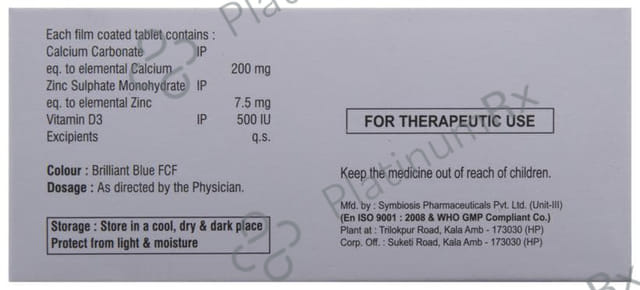
More Medicines With Elemental Calcium 200mg + Vitamin D3 (Cholecalciferol) 500IU + Zinc (Elemental Zinc) 7.5mg
Top Selling Medicines
Top Selling Devices
Top Selling Health Products