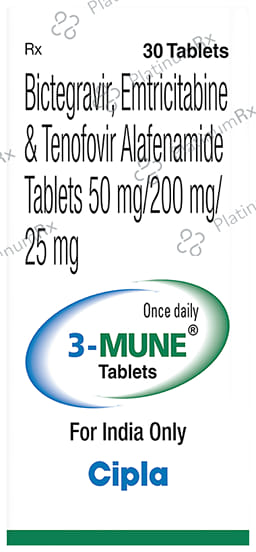
3 Mune Tablet 30s

3 Mune Tablet is a single tablet with three anti-HIV medicines: bictegravir, emtricitabine and tenofovir alafenamide. These are sometimes shortened to BIC, FTC and TAF. Doctors prescribe it as a complete treatment for HIV-1 infection in adults and in children who weigh at least 14 kg. People who have never had HIV treatment can start on it. Some people whose virus is already under control may switch to it from another regimen. 3 Mune Tablet does not remove HIV from the body. Taken every day, it keeps the amount of virus in the blood low, which helps protect the immune system.


Delivery by
...
FDA & GMP Certified
Long Expiry (>8 Months)
15 Days Easy Returns
Medicine Comparison
Have a question?

Genuine Medicine
Pay On Delivery
Secure Payment

LegitScript Certified Online Pharmacy


More About 3 Mune Tablet
Quick Summary
3 Mune Tablet is a single tablet with three anti-HIV medicines: bictegravir, emtricitabine and tenofovir alafenamide. These are sometimes shortened to BIC, FTC and TAF. Doctors prescribe it as a complete treatment for HIV-1 infection in adults and in children who weigh at least 14 kg. People who have never had HIV treatment can start on it. Some people whose virus is already under control may switch to it from another regimen. 3 Mune Tablet does not remove HIV from the body. Taken every day, it keeps the amount of virus in the blood low, which helps protect the immune system.
Detailed Description
HIV is a virus that infects the body's immune cells and uses them to make copies of itself. Over time, this weakens the body's ability to fight infections. 3 Mune Tablet blocks two separate steps the virus needs to multiply.
Bictegravir belongs to a group called integrase strand transfer inhibitors. It stops the virus from inserting its genetic material into the DNA of human cells. Emtricitabine is a nucleoside reverse transcriptase inhibitor, and tenofovir alafenamide is a nucleotide reverse transcriptase inhibitor. Together they are called NRTIs. They stop the virus from copying its genetic code into DNA. Because the medicines act at different steps, they work together against the virus.
3 Mune Tablet is a complete regimen on its own, so it is not taken with other HIV medicines. The usual pattern is one tablet once a day, with or without food. Having all three medicines in one daily tablet can make it easier to stay on treatment. HIV treatment is long-term, and it works best when no doses are missed.
Before you start 3 Mune Tablet, your doctor will test you for hepatitis B. Emtricitabine and tenofovir also act against the hepatitis B virus. The medicine carries a Boxed Warning, which is the strongest safety warning on a drug label. People who have both HIV and hepatitis B can have a severe flare-up of liver disease after stopping 3 Mune Tablet. For this reason, it must never be stopped without the doctor's advice. People with both infections need liver check-ups for several months after stopping.
Your doctor will check your kidney function with blood and urine tests before and during treatment. The urine tests include checks for sugar and protein in the urine. If you already have kidney disease, the phosphate level in your blood may also be checked. Some medicines can lower the amount of 3 Mune Tablet in the blood. These include rifampicin for tuberculosis, certain medicines for fits and the herbal product St. John's wort. This can stop the treatment from working and let the virus become resistant. Always tell your doctor about every medicine, antacid, supplement and herbal product you take.
Benefits of 3 Mune Tablet
- Complete HIV regimen in one tablet - 3 Mune Tablet contains three active medicines, so no other HIV medicine is needed alongside it.
- Once-daily dosing - One tablet a day, with or without food, is easier to fit into daily life.
- Two lines of attack against the virus - The medicines block two different enzymes the virus needs, integrase and reverse transcriptase.
- Lowers the amount of virus - Taken regularly, it helps keep the level of HIV in the blood low, so the immune system can stay stronger.
- Suitable for a wide range of patients - Adults and children who weigh at least 14 kg can use it. A lower-strength tablet is available for smaller children.
- Option for switching - People whose virus is already well controlled on another regimen may be moved to 3 Mune Tablet if their doctor finds it suitable.
Side Effects of 3 Mune Tablet
Common Side Effects (Usually Mild and may lessen with continued use)
- Diarrhoea
- Nausea (feeling sick)
- Headache
- Dizziness
- Tiredness (fatigue)
- Unusual or vivid dreams
- Low mood (depression)
Weight and blood fat or sugar levels may increase during HIV treatment. Your doctor will monitor these.
Serious Side Effects (Seek Urgent Medical Attention)
- Hepatitis B flare-up after stopping - In people who also have hepatitis B, stopping 3 Mune Tablet can make liver disease suddenly much worse. Watch for yellow skin or eyes, dark urine, pale stools, loss of appetite or pain on the right side of the belly.
- Immune reconstitution syndrome - As the immune system gets stronger, it may start reacting to infections that were hidden in the body. This can cause new fever, swollen glands or other signs of infection. Autoimmune conditions can also appear, where the immune system attacks the body's own tissues. These may show up as muscle weakness, tingling or a racing heart.
- Kidney problems - New or worsening kidney damage has been reported, including sudden kidney failure and Fanconi syndrome. In Fanconi syndrome, the tiny tubes in the kidneys leak important minerals into the urine. It can cause bone pain, weakness and passing much more urine than usual.
- Lactic acidosis - This is a dangerous build-up of acid in the blood. Signs include unusual tiredness, muscle pain, fast or difficult breathing, stomach pain with nausea and vomiting, cold hands and feet, or dizziness.
- Severe liver problems - The liver may become enlarged and fatty. Signs include yellow skin or eyes, dark urine and pain in the upper right belly.
- Serious skin and allergic reactions - These include Stevens-Johnson syndrome and toxic epidermal necrolysis. These are rare but severe reactions that cause a spreading rash, blisters, peeling skin and sores in the mouth or eyes. Swelling of the face, lips or throat (angioedema) and hives have also been reported.
- Serious mood changes - Depression, suicidal thoughts and suicide attempts have been reported, mostly in people who already had depression or other mental health conditions.
Directions for Use
- 3 Mune Tablet is a tablet taken by mouth once a day. Your doctor decides the exact dose.
- It can be taken with or without food.
- Swallow the tablet whole with a glass of plain water.
- If a child cannot swallow the smaller children's tablet whole, it can be split. The child must take all the pieces within about 10 minutes.
- Taking it at the same time every day keeps the amount of medicine in your blood steady.
- People on dialysis take their dose after the dialysis session on dialysis days.
- If you use antacids that contain aluminium or magnesium, space them out from 3 Mune Tablet. The tablet goes at least 2 hours before or 6 hours after the antacid.
- Calcium or iron supplements and calcium-containing antacids can be taken together with 3 Mune Tablet if you take them with food. Do not take 3 Mune Tablet on an empty stomach at the same time as these products.
- Keep taking 3 Mune Tablet every day, even when you feel well. Do not change your dose or stop without speaking to your doctor.
- Refill your prescription before you run out so that you do not miss any doses.
How it works
HIV has to complete several steps inside a human cell before it can make new virus particles. 3 Mune Tablet blocks two of these steps.
Bictegravir blocks an HIV enzyme called integrase. An enzyme is a protein that helps a chemical reaction happen. HIV uses integrase to insert its own genetic material into the DNA of the infected human cell. Once this happens, the cell starts making new virus. Bictegravir stops the "strand transfer" step of this insertion, so the virus cannot build itself into the cell's DNA.
Emtricitabine is a lookalike of cytidine, one of the natural building blocks of DNA. Inside the cell, it is changed into its active form. HIV uses an enzyme called reverse transcriptase to build DNA from its own genetic code. The virus mistakes emtricitabine for the real building block and adds it to the growing DNA chain. Once emtricitabine is in place, no more building blocks can be added, so the DNA chain stops short.
Tenofovir alafenamide is a prodrug, which means it is an inactive form that the body converts into the active medicine. Inside cells, it is changed into tenofovir, and then into the active form, tenofovir diphosphate. This active form also blocks reverse transcriptase and stops the viral DNA chain from growing.
Combined effect - One medicine blocks integrase and two block reverse transcriptase. Attacking the virus at two steps with three medicines makes it harder for HIV to multiply and to become resistant.
Safety Advice for 3 Mune Tablet

Pregnancy
Limited information
Data from pregnant people have not shown a higher risk of birth defects or miscarriage with this medicine. Levels of the medicine in the blood can be lower during pregnancy, so your doctor may check your viral load (the amount of HIV in your blood) more often. Do not stop the medicine if you become pregnant. Speak to your doctor first.

Breastfeeding
Limited information
Bictegravir, emtricitabine and tenofovir have been found in breast milk. Breastfeeding can pass HIV to a baby who does not have it. In a baby who already has HIV, it can lead to drug-resistant virus. It can also cause side effects in the baby. Discuss feeding options with your doctor.

Alcohol
Limited information
The label does not list a direct interaction. Alcohol can strain the liver, and it may make it harder to remember daily doses. Ask your doctor how much, if any, is safe for you.

Driving
Limited information
Dizziness has been reported with this medicine. If you feel dizzy, tired or unwell, do not drive or use machines.

Kidney
Limited information
Not recommended for people with severe kidney disease (creatinine clearance 15 to below 30 mL/min). It is also not recommended for people with end-stage kidney disease who are not on regular dialysis. Some adults on regular dialysis whose virus is already controlled may use it. Your kidney function will be checked with blood and urine tests during treatment.

Liver
Limited information
Not recommended in severe liver impairment. People who also have hepatitis B need close liver monitoring, especially after stopping the medicine.

Children
Limited information
Approved for children who weigh at least 14 kg. Children who weigh 14 kg to less than 25 kg use a lower-strength tablet.

Elderly patients
Limited information
Has been studied in people aged 65 and over. Your doctor should regularly review your kidney function and your other medicines.
Quick Tips for 3 Mune Tablet
- Set a daily phone alarm so you take 3 Mune Tablet at the same time every day.
- Never run out of tablets. Missing doses can let the virus become resistant.
- Keep antacids with aluminium or magnesium at least 2 hours after or 6 hours before your dose.
- Take calcium or iron supplements together with 3 Mune Tablet and a meal.
- Tell every doctor, including your tuberculosis or epilepsy doctor, that you take 3 Mune Tablet.
- Do not take St. John's wort. It can lower the amount of medicine in your blood and stop it from working.
- If you have hepatitis B, never stop 3 Mune Tablet without your doctor's advice.
- Report low mood or any thoughts of self-harm to your doctor straight away.
- Keep your scheduled kidney blood and urine tests.
Storage Advice
- Bottle - Store below 30°C (86°F). Keep the bottle tightly closed.
- Blister pack - Store at room temperature between 20°C and 25°C (68°F and 77°F).
- Keep the tablets in the original bottle or blister pack to protect them from moisture.
- The bottle contains a desiccant packet that keeps the tablets dry. Leave it in the bottle and do not eat it.
- Do not use the bottle if the seal over the opening is broken or missing.
- Keep out of the reach and sight of children and pets.
Drug-Food Interaction
- Food in general - 3 Mune Tablet can be taken with or without meals.
- Calcium or iron supplements and calcium-containing antacids - These can bind to bictegravir and reduce how much your body absorbs. They can be taken at the same time as 3 Mune Tablet if you take them with food. Do not take 3 Mune Tablet on an empty stomach at the same time as these products, or within 2 hours after taking them.
- Antacids containing aluminium or magnesium - 3 Mune Tablet should be taken at least 2 hours before or 6 hours after these antacids.
- St. John's wort - Must not be used with 3 Mune Tablet. It lowers the levels of bictegravir and tenofovir alafenamide, which can stop the treatment from working.
Interactions with Other Drugs
- Rifampicin (Rifampin) - Must not be used with 3 Mune Tablet. It greatly lowers bictegravir levels. This can stop the treatment from working and lead to resistance.
- Dofetilide (heart rhythm medicine) - Must not be used with 3 Mune Tablet. Dofetilide levels can rise and cause serious, life-threatening effects.
- Rifabutin and rifapentine - Not recommended, as they lower the levels of bictegravir and tenofovir alafenamide.
- Medicines for fits (carbamazepine, oxcarbazepine, phenobarbital, phenytoin) - These lower the levels of bictegravir and tenofovir alafenamide. Your doctor may choose a different medicine for fits.
- St. John's wort - Must not be used with 3 Mune Tablet. It lowers medicine levels and can lead to treatment failure and resistance.
- Antacids, laxatives and supplements containing aluminium, magnesium, calcium or iron - These can reduce absorption. Follow the timing rules your doctor or pharmacist gives you.
- Metformin - 3 Mune Tablet can raise metformin levels. Your doctor may review your diabetes treatment.
- Other HIV medicines - 3 Mune Tablet is a complete regimen and should not be combined with other HIV medicines.
- Medicines that can harm the kidneys - Using these with 3 Mune Tablet may raise the risk of kidney side effects. Tell your doctor about any painkillers or other long-term medicines you use.
Drug-Disease Interactions
- Allergy - Do not take 3 Mune Tablet if you are allergic to bictegravir, emtricitabine, tenofovir alafenamide or any other ingredient in the tablet.
- Hepatitis B - Hepatitis B can flare up badly after stopping 3 Mune Tablet. You will be tested for hepatitis B before starting, and liver checks continue after stopping.
- Kidney disease - Not recommended in severe kidney disease or in end-stage kidney disease without regular dialysis. New or worsening kidney problems, including Fanconi syndrome, have been reported. If you have long-term kidney disease, your blood phosphate level may also be checked.
- Severe liver disease - Not recommended.
- Depression or other mental health conditions - Suicidal thoughts and depression were seen mostly in people with a history of these problems. Your doctor will need to follow you up closely.
- Hidden infections such as tuberculosis - Hidden infections may flare up as the immune system recovers (immune reconstitution syndrome). Tell your doctor about any past infections.
- Pregnancy - Medicine levels are lower during pregnancy, so your viral load (the amount of HIV in your blood) needs closer checking.
Daily Dose
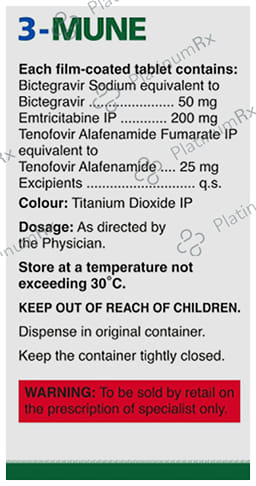
- Adults and children weighing at least 25 kg - The usual dose is one tablet (bictegravir 50 mg, emtricitabine 200 mg, tenofovir alafenamide 25 mg) once daily, with or without food.
- Children weighing 14 kg to less than 25 kg - The usual dose is one tablet (bictegravir 30 mg, emtricitabine 120 mg, tenofovir alafenamide 15 mg) once daily, with or without food.
- Children weighing less than 14 kg - Not recommended. There is no approved dose for this weight group.
- Adults on regular haemodialysis - The usual dose is one adult tablet once daily, taken after dialysis on dialysis days, as directed by the specialist.
- Maximum frequency - Once in 24 hours.
- Always follow the exact dose your doctor prescribes. Do not change the dose or stop on your own.
Overdose
There is no information about overdose of 3 Mune Tablet in patients, so its effects are hard to predict. If you or someone else has taken more than the prescribed dose, go to the nearest emergency department or call for medical help immediately. Take the medicine pack with you. Hospital staff will check heart rate, blood pressure and breathing, and will give supportive care. Dialysis can remove some emtricitabine and tenofovir from the blood.
What If You Forget to take 3 Mune Tablet?
- If you remember within 18 hours of your usual time, take the missed tablet as soon as possible, then continue as normal.
- If more than 18 hours have passed, skip the missed tablet and take the next one at your usual time.
- If you vomit within 1 hour of taking your tablet, take another tablet. If you vomit more than 1 hour after, do not take another.
- Never take two tablets at once to make up for a missed dose.
- Missing doses can let HIV become resistant. If you often forget, ask your doctor or pharmacist for tips.
When to contact doctor
- Yellow skin or eyes, dark urine, pale stools, or pain in the upper right belly
- Fast or difficult breathing, unusual muscle pain, severe tiredness, cold hands and feet, or dizziness
- Passing much more or much less urine than usual, bone pain or swelling in the legs
- A spreading rash, blisters, peeling skin, or sores in the mouth or eyes
- Swelling of the face, lips, tongue or throat, or trouble breathing
- New fever, swollen glands, or other signs of infection soon after starting treatment
- Low mood, hopelessness, or thoughts of harming yourself
- Becoming pregnant while taking 3 Mune Tablet
FAQ
Fact Box
Therapeutic Class
Antiretroviral (anti-HIV)
Action Class
Integrase strand transfer inhibitor (bictegravir) + nucleoside/nucleotide reverse transcriptase inhibitors (emtricitabine, tenofovir alafenamide)
Chemical Class
Bictegravir: polycyclic carbamoyl pyridone derivative; Emtricitabine: synthetic cytidine (nucleoside) analogue; Tenofovir alafenamide: phosphonamidate prodrug of tenofovir (acyclic adenosine nucleotide analogue)
Habit Forming
No
Disclaimer
PlatinumRx is committed to providing reliable and accurate information to support informed customer decisions. However, all information made available on the Platform, including product descriptions, comparisons, and other content, is provided solely for general informational purposes. Such information is not intended to diagnose, prevent, treat, or cure any medical condition, nor should it be relied upon as a substitute for professional medical advice, diagnosis, or treatment.

Customers also bought








More Medicines By Cipla Ltd.
More Medicines With Bictegravir 50mg + Emtricitabine 200mg + Tenofovir Alafenamide 25mg
Top Selling Medicines
Top Selling Devices
Top Selling Health Products