

Extra ₹100 off on medicines

Rivaclot 10mg Tablet

atom-spiralsSalt Composition:Rivaroxaban 10mg

Rivaclot 10mg Tablet is a blood thinner, also called an anticoagulant, that you take by mouth. It contains one active ingredient, rivaroxaban, and belongs to a group of medicines called direct oral anticoagulants (DOACs). Doctors prescribe it to lower the chance of stroke in people with an irregular heartbeat called atrial fibrillation that is not caused by a heart valve problem. It also treats blood clots in the legs (deep vein thrombosis, or DVT) and lungs (pulmonary embolism, or PE), and helps stop these clots from coming back. It can prevent clots after hip or knee replacement surgery. In some people with heart or leg artery disease, it is given with aspirin to lower the risk of heart attack and stroke.

Read more

Written by: Syeda Jigni Mehraj, B pharmacy

Reviewed by: Dr. Jay Faldu, MBBS

Last updated on: 26-10-2026
Same Composition
Same Strength
FDA Approved
Same Composition
Currently Viewing
Rivaclot 10mg Tablet

Olcare Laboratories

Strip of 7 tablets

See affordable match

Top Substitute
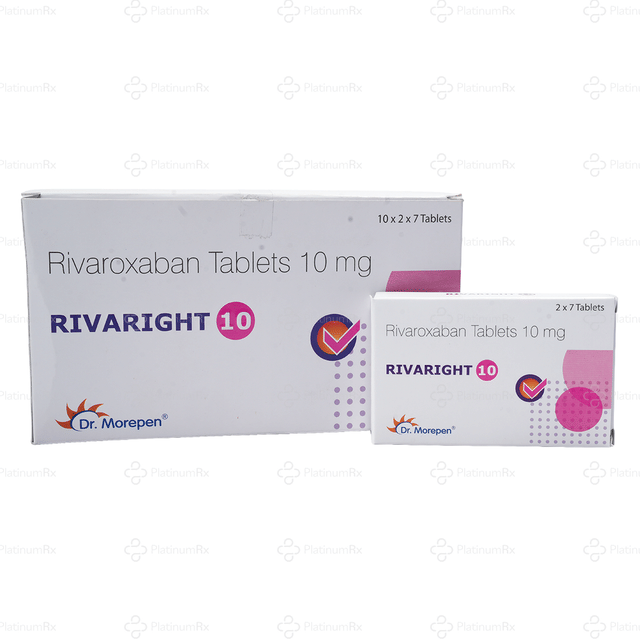
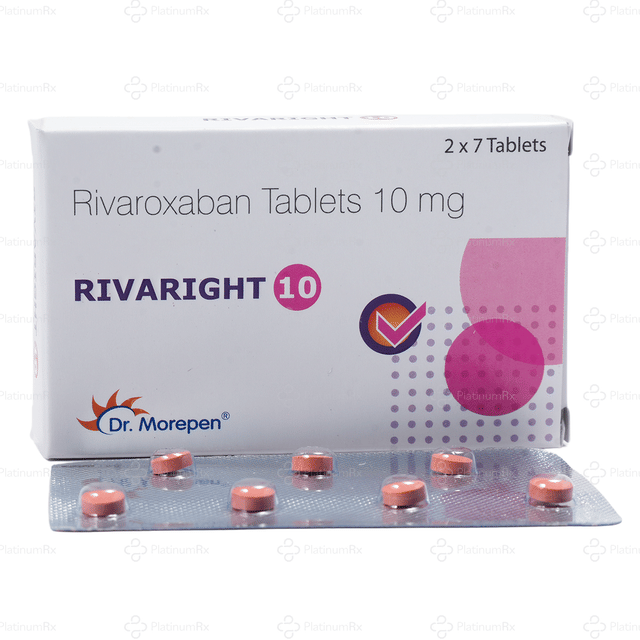
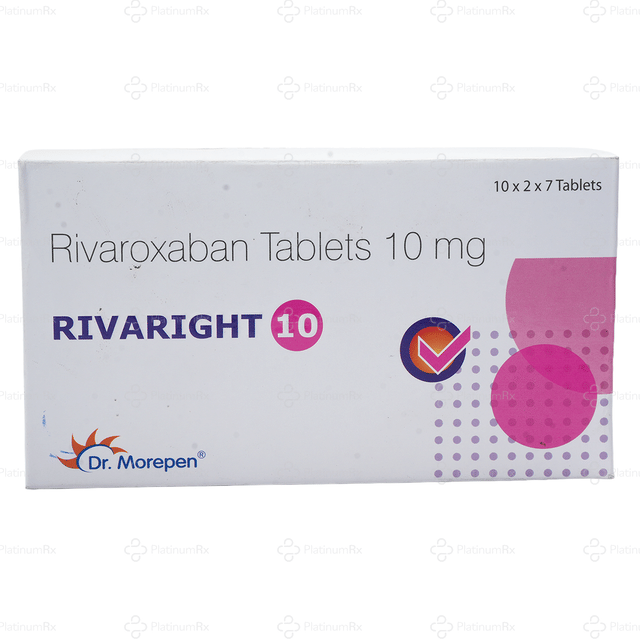
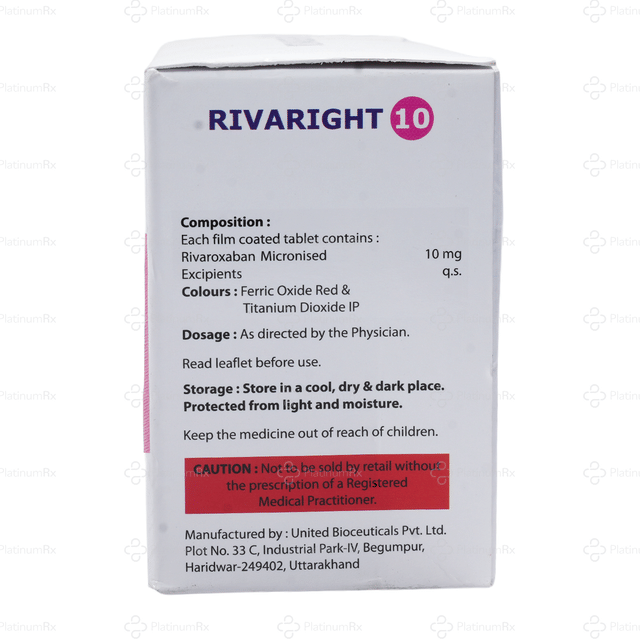
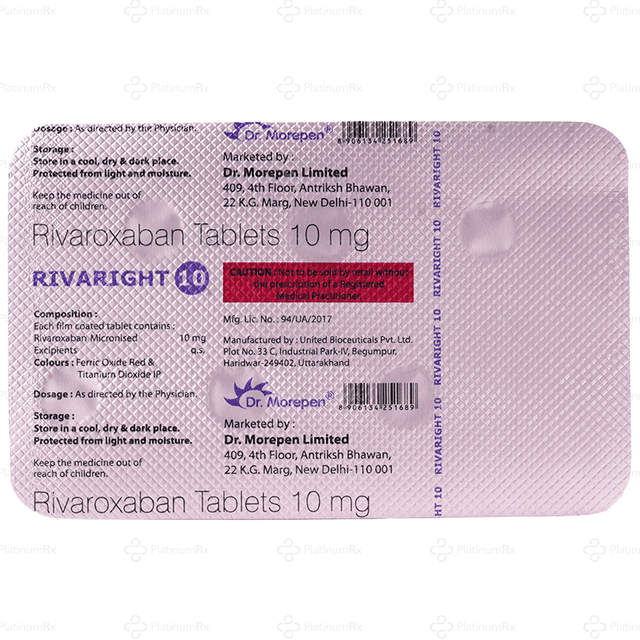
Rivaright 10mg Tablet 7s

Dr. Morepen Ltd.

Strip of 7 tablets
4.8K Bought this instead

Delivery by

...

FDA & GMP Certified

Long Expiry (>8 Months)

15 Days Easy Returns

Medicine Comparison

100% Exact Salt Match
Rivaclot 10mg Tablet
Rivaright 10mg Tablet 7s
FDA Approved
FDA Approved
₹14.3 / Unit
₹10.4 / Unit

Have a question?

Doctor Approved & Trusted
thumbnail

Genuine Medicine

Pay On Delivery

Secure Payment

LegitScript Certified

LegitScript Certified Online Pharmacy

More About Rivaclot 10mg Tablet

Detailed Description

Your blood clots by setting off a chain of steps. Each step switches on a protein called a clotting factor. One of the key proteins in this chain is called factor Xa. Rivaclot 10mg Tablet blocks factor Xa directly. This means less thrombin is made. Thrombin is the protein that builds the mesh that holds a clot together. With less thrombin, harmful clots are less likely to form or grow inside your blood vessels.

Doctors use Rivaclot 10mg Tablet for several conditions:

  • Lowering the risk of stroke and blood clots in people with atrial fibrillation not caused by a heart valve problem
  • Treating DVT and PE, and lowering the chance of them coming back
  • Preventing clots after hip or knee replacement surgery
  • Preventing clots in some adults who are in hospital for a serious illness and cannot move around much
  • Lowering the risk of heart attack, stroke, and serious leg artery events in people with coronary artery disease (narrowed heart arteries) or peripheral artery disease (narrowed leg arteries), taken along with low-dose aspirin
  • Treating and preventing clots in some children, under specialist care

Older blood thinners like warfarin need regular blood tests (INR checks) and careful attention to vitamin K in food. Rivaclot 10mg Tablet does not usually need routine INR checks, and vitamin K in food does not change how it works. It is taken at fixed doses. This makes daily life simpler for many people.

Because Rivaclot 10mg Tablet thins the blood, its main risk is bleeding. Sometimes this bleeding can be serious. The US label has a boxed warning, the strongest kind of safety warning, about two risks. First, stopping the medicine early without a plan from your doctor raises the risk of stroke and clots. Second, people who have spinal or epidural anaesthesia (a numbing injection into the lower back, often used for surgery or childbirth), or a spinal tap, while taking it can develop a blood clot around the spinal cord. This can cause lasting paralysis. Your doctor will check your kidney and liver function before and during treatment. Always tell every doctor and dentist you see that you take Rivaclot 10mg Tablet.

Benefits of Rivaclot 10mg Tablet

  1. Lowers stroke risk in atrial fibrillation - It helps prevent clots that can form in an irregularly beating heart and travel to the brain.
  2. Treats and prevents leg and lung clots - It treats DVT and PE and lowers the chance that they come back.
  3. Protects after joint surgery - It reduces the risk of clots after hip or knee replacement.
  4. No routine INR blood tests - Unlike warfarin, it does not usually need regular blood tests to adjust the dose.
  5. Few food limits - Vitamin K in green leafy vegetables does not change how well it works.
  6. Simple dosing - Many people take it just once a day.
  7. Heart and leg artery protection - At a low dose with aspirin, it lowers the risk of heart attack, stroke, and serious leg artery problems in some people with long-term artery disease.

Side Effects of Rivaclot 10mg Tablet

Common Side Effects (Usually Mild)

  • Bruising more easily
  • Nosebleeds
  • Bleeding gums
  • Longer bleeding from small cuts
  • Heavier menstrual periods
  • Feeling tired or dizzy, sometimes linked to a low red blood cell count (anaemia)
  • Stomach pain, indigestion, or nausea
  • Itching
  • Back pain or pain in the arms and legs

Serious Side Effects (Seek Urgent Medical Attention)

  • Major bleeding - red, pink, or brown urine; red or black, tarry stools; vomiting blood or vomit that looks like coffee grounds; coughing up blood; a nosebleed that will not stop
  • Bleeding in the brain - sudden severe headache, confusion, weakness on one side of the body, trouble speaking, or seeing problems
  • Spinal or epidural haematoma - a collection of blood around the spinal cord. It can happen if you have a spinal or epidural injection or a spinal tap while on this medicine. Warning signs include back pain, tingling, numbness, or muscle weakness (especially in the legs), or losing control of your bladder or bowels. This can cause paralysis, so get help right away.
  • Stevens-Johnson syndrome - a rare but serious skin reaction with blistering, peeling skin, and sores in the mouth or eyes, often starting with fever and flu-like feelings
  • Serious allergic reaction - swelling of the face, lips, tongue, or throat, trouble breathing, hives, or chest tightness
  • Liver problems - yellowing of the skin or eyes (jaundice), dark urine, or pain in the upper right side of the belly
  • Unusual weakness, paleness, fainting, or a fast heartbeat, which can be signs of hidden bleeding

Directions for Use

  • Take Rivaclot 10mg Tablet exactly as your doctor prescribed, at the same time each day.
  • The 15 mg and 20 mg tablets must be taken with food. Food helps your body absorb these strengths properly. If you take it once a day for atrial fibrillation, it is usually taken with your evening meal.
  • The 2.5 mg and 10 mg tablets can be taken with or without food.
  • Swallow the tablet whole with a glass of plain water.
  • If you have trouble swallowing tablets, talk to your doctor or pharmacist before changing how you take it. The label allows the tablets to be crushed and mixed with a little applesauce just before you take them. A 15 mg or 20 mg dose taken this way must be followed right away by food.
  • Children may be given a liquid form. Measure it with the oral syringe provided, not a kitchen spoon.
  • Keep taking it for as long as your doctor tells you to. Do not stop on your own, because stopping early raises your risk of stroke and blood clots.
  • If you need surgery, a dental procedure, or any spinal injection, your doctor will tell you if and when to pause the medicine.

How it works

Blood clotting works like a chain of switches. One switch turns on the next until a solid clot forms. Factor Xa sits at a key point in this chain, where two clotting pathways meet. Its job is to turn prothrombin into thrombin. Thrombin then turns fibrinogen into fibrin, which forms the threads that hold a clot together.

Rivaclot 10mg Tablet is a "direct factor Xa inhibitor". This means it attaches straight to factor Xa and blocks it. It does not need a helper protein in the blood to do this, unlike heparin, which needs one called antithrombin. Rivaclot 10mg Tablet can block factor Xa that is floating freely in the blood and factor Xa that is already caught up inside a forming clot.

When factor Xa is blocked, the body makes less thrombin, so fewer fibrin threads form. Clots become less likely to start or grow. Rivaclot 10mg Tablet does not act directly on platelets, the tiny blood cells that clump together at a wound. It does not dissolve clots that have already formed either. Instead, it stops them from getting bigger while your body slowly breaks them down.

The effect begins within a few hours of a dose and fades as the medicine leaves the body. This is why taking every dose on time matters. Both the kidneys and the liver help clear Rivaclot 10mg Tablet from the body.

Safety Advice for Rivaclot 10mg Tablet

icon
Pregnancy
Limited information

Rivaclot 10mg Tablet should not be used during pregnancy. It can cause serious bleeding in the mother and may harm the unborn baby. If you could become pregnant, use reliable birth control while taking it. Tell your doctor right away if you become pregnant or plan to.

icon
Breastfeeding
Limited information

Rivaclot 10mg Tablet passes into breast milk and should not be used while breastfeeding. Your doctor will help you decide whether to stop breastfeeding or switch to a different blood thinner.

icon
Alcohol
Limited information

Drinking a lot of alcohol, especially binge drinking, raises your risk of bleeding. Keep alcohol low and follow your doctor's advice.

icon
Driving
Limited information

It may cause dizziness or fainting in some people. Do not drive or use machines if you feel dizzy or faint.

icon
Kidney
Limited information

Use with caution. Your doctor may lower the dose or avoid it, depending on how well your kidneys work. Kidney tests are done before and during treatment.

icon
Liver
Limited information

Avoid in moderate to severe liver disease, or any liver disease that affects blood clotting, because the risk of bleeding is higher.

icon
Children
Limited information

Used in children only for certain clotting conditions, under a specialist, with doses based on body weight.

icon
Elderly patients
Limited information

Older adults may have a higher risk of bleeding and often have weaker kidneys. Regular check-ups and kidney tests help keep treatment safe.

Quick Tips for Rivaclot 10mg Tablet

  • Take the 15 mg and 20 mg tablets with a meal every time.
  • Set a daily alarm so you take every dose on time.
  • Carry an anticoagulant alert card and tell every doctor, dentist, and pharmacist that you take Rivaclot 10mg Tablet.
  • Check with your pharmacist before taking any painkiller. Medicines such as ibuprofen, diclofenac, and aspirin raise bleeding risk.
  • Do not take St John's wort or other herbal products without asking your doctor.
  • Watch for pink or brown urine, black stools, or unusual bruising, and report them quickly.
  • Never stop the medicine on your own. Ask your doctor first, even before surgery or dental work.
  • Refill your prescription before you run out.

Storage Advice

  • Store at room temperature, between 20°C and 25°C (68°F to 77°F). Short periods between 15°C and 30°C (59°F to 86°F) are acceptable.
  • Keep tablets in the original pack, away from moisture, heat, and direct sunlight. Do not store in the bathroom.
  • If you have the liquid form, follow the storage and discard dates on the bottle.
  • Keep out of the sight and reach of children and pets.
  • Do not use tablets after the expiry date. Ask your pharmacist how to dispose of unused medicine safely.

Drug-Food Interaction

  • Meals - The 15 mg and 20 mg tablets need food for proper absorption. Taken on an empty stomach, less of the medicine gets into your body, and it may protect you less well.
  • Vitamin K foods - Green leafy vegetables like spinach do not change how Rivaclot 10mg Tablet works, so you do not need to limit them as you would with warfarin.
  • Alcohol - Heavy drinking increases the risk of stomach bleeding and other bleeding.
  • Herbal products - St John's wort can lower Rivaclot 10mg Tablet levels in the blood and should be avoided.

Interactions with Other Drugs

  • Other blood thinners (warfarin, heparin, enoxaparin, apixaban, dabigatran) - These should not normally be taken together. If you are switching from one blood thinner to another, your doctor will tell you exactly when to stop one and start the other. A short overlap is used only when moving onto warfarin.
  • Antiplatelet medicines (aspirin, clopidogrel, prasugrel, ticagrelor) - These add to the bleeding risk. Low-dose aspirin is sometimes prescribed with Rivaclot 10mg Tablet on purpose, but only under a doctor's supervision.
  • Painkillers called NSAIDs (ibuprofen, diclofenac, naproxen) - These raise the risk of bleeding, especially stomach bleeding.
  • Antidepressants called SSRIs and SNRIs (fluoxetine, sertraline, venlafaxine) - These can increase bleeding risk.
  • Strong antifungals and HIV medicines (ketoconazole, itraconazole, ritonavir) - These raise Rivaclot 10mg Tablet levels in the blood and the risk of bleeding. Using them together should be avoided.
  • Rifampicin, carbamazepine, phenytoin, and St John's wort - These lower Rivaclot 10mg Tablet levels and may make it work less well, raising the risk of clots. Using them together should be avoided.
  • Clarithromycin, erythromycin, and some heart medicines (such as verapamil) - These may raise Rivaclot 10mg Tablet levels. Your doctor will weigh the risk, especially if your kidneys are weak.
  • Dronedarone (a heart rhythm medicine) - This should generally not be taken with Rivaclot 10mg Tablet.

Drug-Disease Interactions

  • Allergy - Do not take Rivaclot 10mg Tablet if you have ever had a serious allergic reaction to rivaroxaban or any ingredient in the tablet or liquid.
  • Active bleeding - Do not use Rivaclot 10mg Tablet if you are bleeding right now, for example from a stomach ulcer or in the brain.
  • Artificial (prosthetic) heart valves - Not recommended in people with mechanical heart valves.
  • Antiphospholipid syndrome - In people with this immune clotting disorder, especially those who test positive on all three antibody tests, Rivaclot 10mg Tablet has been linked to more repeat clots than warfarin. It is not recommended for them.
  • Liver disease - Moderate to severe liver disease, or liver disease that affects clotting, raises bleeding risk and is a reason to avoid it.
  • Kidney disease - Weak kidneys let the medicine build up. Your doctor may change the dose or choose a different medicine.
  • Spinal or epidural procedures - These carry a risk of bleeding around the spinal cord. The timing of doses must be planned carefully by your doctors.
  • Conditions with high bleeding risk - Recent surgery, recent brain or eye bleeding, very high blood pressure that is not controlled, or a bleeding disorder all need careful review before starting.

Daily Dose

  • Tablets come in 2.5 mg, 10 mg, 15 mg, and 20 mg strengths. A liquid form is available for children.
  • For most adult uses, the dose is between 10 mg and 20 mg once a day. When used with aspirin for heart or leg artery disease, it is 2.5 mg twice a day.
  • At the start of treatment for a new DVT or PE, the usual dose is 15 mg twice a day with food for the first 21 days (30 mg a day in total), followed by 20 mg once a day with food. Your doctor will confirm your exact plan.
  • Your doctor will choose your dose based on your condition, kidney function, body weight (for children), and other medicines you take.
  • Follow the exact dose and timing your doctor prescribes. Do not change it or stop it on your own.

Overdose

Taking too much Rivaclot 10mg Tablet mainly raises the risk of bleeding. Signs may include:

  • Bleeding from the gums or nose that will not stop
  • Red, pink, or brown urine
  • Black or bloody stools
  • Vomiting blood or coffee-ground-like material
  • Large or unexplained bruises
  • Severe headache, dizziness, weakness, or fainting

If you think you or someone else has taken too much, go to the nearest emergency department right away. Take the medicine pack with you. Hospital staff may give activated charcoal if the overdose was recent, to reduce how much is absorbed. Doctors may also use treatments to control bleeding, including a specific reversal medicine (andexanet alfa) where it is available. Dialysis does not remove Rivaclot 10mg Tablet from the blood.

What If You Forget to take Rivaclot 10mg Tablet?

  • If you take it once a day - Take the missed dose as soon as you remember on the same day. Then go back to your usual time the next day. Do not take two doses on the same day to make up for a missed one.
  • If you take 15 mg twice a day (the first weeks of clot treatment) - Take the missed dose as soon as you remember, so you still get your full daily amount. In this case only, you may take two 15 mg tablets at the same time if needed. Then return to your usual schedule the next day.
  • If you take 2.5 mg twice a day - Skip the missed dose and take the next one at the usual time. Do not double up.
  • If you are not sure what to do, call your doctor or pharmacist.

When to contact doctor

Get urgent medical help if you notice:

  • Bleeding that is heavy or will not stop
  • Red, pink, or brown urine, or red or black, tarry stools
  • Coughing up blood or vomiting blood or coffee-ground-like material
  • Sudden severe headache, confusion, trouble speaking, weakness on one side, or changes in vision
  • Back pain, numbness, tingling, or leg weakness, or loss of bladder or bowel control, especially after a spinal or epidural injection
  • Fainting, severe dizziness, or unusual weakness
  • Swelling of the face, lips, or throat, or trouble breathing
  • Blistering or peeling skin with fever
  • Yellow skin or eyes, or dark urine
  • Signs of a new clot, such as leg pain and swelling, sudden shortness of breath, or chest pain

Also tell your doctor if you become pregnant, are planning surgery or dental work, or start any new medicine or herbal product.

FAQ

Fact Box

Therapeutic Class

Anticoagulant (blood thinner)

Action Class

Direct factor Xa inhibitor

Chemical Class

Oxazolidinone derivative

Habit Forming

No

Disclaimer

PlatinumRx is committed to providing reliable and accurate information to support informed customer decisions. However, all information made available on the Platform, including product descriptions, comparisons, and other content, is provided solely for general informational purposes. Such information is not intended to diagnose, prevent, treat, or cure any medical condition, nor should it be relied upon as a substitute for professional medical advice, diagnosis, or treatment.
View More
editorial-png
Authentic & trustworthy information
Having issues with the content?
Report Error

Customers also bought