T-Bact 2% Ointment: View Uses, Side Effects and How to Apply
Last Updated: September 28, 2026
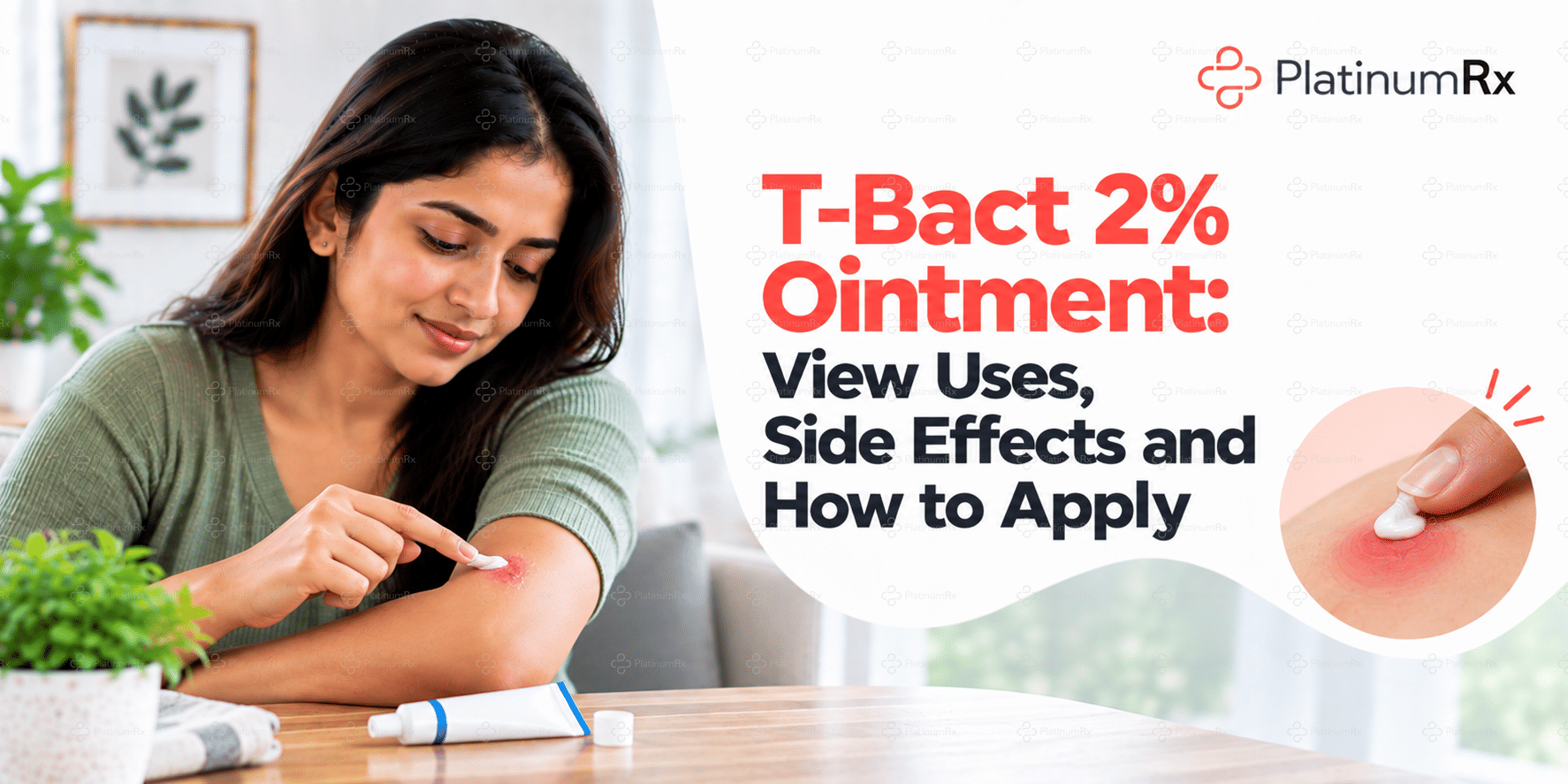
Summary
T-Bact Ointment is a topical antibiotic ointment. Its active ingredient is mupirocin 2% w/w. It is applied to the skin to clear bacterial infections such as impetigo, infected eczema, and small infected cuts, insect bites and wounds.
Key takeaways
- In India, T-Bact Ointment is supplied for the use only of registered medical practitioners, so it should be used only on a doctor's prescription. It should not be started on your own.
- Get medical help immediately if you develop swelling of the face, lips or throat, a spreading rash, or trouble breathing.
What is T-Bact Ointment?
Mupirocin is an antibiotic used on the skin. It is active against the bacteria that cause most common skin infections, including Staphylococcus aureus and Streptococcus pyogenes. It is meant for a diagnosed bacterial infection, not for any red patch or rash.
T-Bact also comes as a cream. The ointment and the cream are not the same product, and they are used for slightly different problems.
- T-Bact Ointment; What it contains: Mupirocin 2.0% w/w; Base: Polyethylene glycol (non-greasy); What the label uses it for: Impetigo, folliculitis, boils and ecthyma; infected eczema; infected minor cuts, grazes, insect bites, wounds and burns; also to prevent infection in small clean cuts and wounds
- T-Bact Cream; What it contains: Mupirocin calcium equivalent to mupirocin 2.0% w/w, with benzyl alcohol and 2-phenoxyethanol as preservatives; Base: Non-greasy cream base; What the label uses it for: Secondarily infected traumatic lesions, such as small cuts, sutured wounds and grazes
How T-Bact Ointment works
Mupirocin blocks a specific enzyme inside bacteria, called isoleucyl transfer-RNA synthetase. Bacteria need this enzyme to build the proteins they need to live. Once mupirocin blocks it, they cannot build those proteins and they stop growing.
At the concentrations reached when the ointment is applied to the skin, mupirocin kills many of the bacteria that cause common superficial skin infections, including Staphylococcus aureus and streptococci. Because its target is different from that of other antibiotics, mupirocin has not shown cross-resistance with other antibiotic groups.
What T-Bact Ointment is used for
T-Bact Ointment is used for bacterial skin infections. The Indian label lists these:
- Primary skin infections: impetigo (a contagious, crusted skin infection), folliculitis (infection of the hair roots), furunculosis (boils) and ecthyma.
- Infections on top of another skin problem: infected eczema and similar conditions.
- Infected minor injuries: small cuts, grazes, insect bites, and minor wounds and burns that do not need hospital care.
- Preventing infection: on small clean wounds, cuts and surgical incisions, to stop them becoming infected.
In the US, the FDA approves mupirocin ointment for impetigo only. In India, the label covers a wider range of bacterial skin infections.
What it is not for
- Fungal infections such as ringworm, athlete's foot or a yeast rash. Mupirocin is an antibacterial and does not work on fungi.
- Viral skin problems such as cold sores or chickenpox.
- Acne. Acne is treated with other medicines.
How to apply T-Bact Ointment
Apply a thin layer to the affected skin, as often as your doctor has told you. The label for T-Bact Ointment directs 2 to 3 applications a day, for up to 10 days, depending on how the infection responds. No particular time of day is specified, so use it at the times your doctor advises.
- Wash your hands.
- Clean the affected skin gently, then pat it dry.
- Apply a small quantity over the affected area, covering it thinly.
- Cover the area with a dressing only if your doctor has advised it.
- Wash your hands again afterwards.
- Continue for the number of days your doctor prescribed. Do not go beyond 10 days of treatment unless your doctor tells you to.
Two practical points:
- Do not mix other creams, lotions or ointments with it on the treated area. Mixing can dilute mupirocin and reduce how well it works.
- If the infection has not clearly improved within 3 to 5 days, go back to your doctor rather than continuing on your own.
Stopping impetigo spreading
Impetigo is very contagious. It spreads through skin-to-skin contact, or by touching things such as towels and bedding. Once treatment starts, impetigo usually stops being contagious about 48 hours later. Until then:
- Keep the affected skin washed and covered.
- Wash your hands often, and always before and after you touch the affected skin.
- Do not share towels, flannels or bedding, and wash them at a high temperature.
- Stay away from work, school or nursery until you are no longer contagious.
- Try not to touch or scratch the sores, which also helps prevent scarring.
If you miss a dose, use too much, or want to stop
- Missed dose: Apply it as soon as you remember. If your next application is almost due, skip the missed one and continue as usual. Do not apply a double amount to catch up.
- Too much ointment, or swallowed: Very little mupirocin is absorbed through intact skin, and the label notes there is limited experience of overdose. If the ointment is swallowed, or a large amount is used on broken skin, take the person to the nearest hospital emergency department and carry the tube with you. In India, call 112 for an emergency, or 108 for an ambulance.
- Stopping early: Do not stop the treatment early just because the skin looks better. Unfinished antibiotic treatment lets the infection come back and helps bacteria become resistant. If your doctor asks you to stop, follow that advice.
Who should not use it, and who needs to be careful
Most people can use T-Bact Ointment safely. But one group must not use it, and a few groups should check with a doctor first.
Do not use it if you have ever had an allergic reaction to mupirocin or to any other ingredient in the ointment.
Check with your doctor first if:
- You have kidney problems. The ointment base is polyethylene glycol, which can be absorbed through damaged skin and is cleared by the kidneys. The label says T-Bact Ointment should not be used where a large amount of polyethylene glycol could be absorbed, especially if you have moderate or severe kidney disease. This applies mainly to large open wounds and burns.
- You have liver problems, or you are elderly. The label gives the same 2 to 3 applications a day for adults, children, elderly people and people with liver problems. For elderly people, there are no restrictions unless there is moderate or severe kidney impairment, as described above.
- You have a large, deep or dirty wound, an ulcer, or an extensive burn. These need a doctor's assessment rather than home treatment.
- You are pregnant. The Indian label says there is not enough human data on use in pregnancy, although animal studies have not shown harm to the fetus. The US label adds that the ointment should be used in pregnancy only if clearly needed.
- You are breastfeeding. There is not enough data on use during breastfeeding. If the ointment is being applied to a cracked nipple, wash the area thoroughly before you feed your baby.
- You are treating a baby under 2 months old. The label gives the same instruction for adults and children. The US label says use of the ointment has been studied in children aged 2 months to 16 years. For a newborn, use it only on a doctor's advice.
Sites to avoid
- Do not put it in your eyes or in your nose.
- Do not use it around an intravenous (drip) cannula or a central line.
- If it gets into your eye, rinse the eye thoroughly with water until the ointment is gone.
Other medicines, alcohol and driving
No drug interactions have been identified with mupirocin, and alcohol is not listed as an interaction. No food interactions are known either — the ointment is applied to the skin, so food is not a concern. The ointment is also not known to affect your ability to drive or to use machines. Even so, tell your doctor or pharmacist about the other medicines and creams you use, so that they can check nothing clashes.
Side effects
Most people notice nothing more than mild burning where the ointment is applied.
- Common - up to 1 in 10 people; What you may notice: Burning at the site of application; What to do: Usually mild. Tell your doctor if it is severe or does not settle.
- Uncommon - up to 1 in 100 people; What you may notice: Itching, redness, stinging or dryness at the site, or skin that becomes sensitised to mupirocin or to the ointment base; What to do: Stop using it and tell your doctor.
Very rarely, mupirocin can cause a serious allergic reaction. Get medical help immediately if you notice:
- swelling of the face, lips, tongue or throat
- difficulty breathing or swallowing
- a rash or hives spreading beyond the treated area
- a generalised rash with fever or a feeling of faintness
Get medical help the same day if the infection spreads, becomes very painful or swollen, or you develop a fever or feel unwell.
Also contact your doctor if you develop prolonged or significant diarrhoea, or abdominal cramps, while using the ointment. Antibiotics can cause bowel inflammation, and although this is less likely with an ointment, the label advises stopping the medicine and getting checked.
Resistance: why how you use it matters
Antibiotic resistance is the main long-term concern with mupirocin. When the ointment is used too often, for too long, or for infections it cannot treat, bacteria can stop responding to it.
Resistance has been reported in India. In a 2014 study at a teaching hospital in Barabanki, Uttar Pradesh, covering May 2013 to April 2014, 15 of 82 MRSA isolates (18.3%) were resistant to mupirocin, with 8 showing high-level resistance and 7 low-level resistance. Pooled results from studies worldwide put mupirocin resistance at about 7.6% of all S. aureus isolates and about 13.8% of MRSA isolates, so the Indian figure is a high local reading rather than the general picture. MRSA is a staph germ that many common antibiotics no longer kill. Resistance rates differ widely between hospitals and regions, so treat this as a caution rather than a prediction of what will happen in your case.
What helps:
- Use it only for the bacterial infection your doctor has diagnosed.
- Use it for the prescribed number of days. Using it longer does not clear an infection faster.
- Do not keep a partly used tube for the next time a cut looks red.
- Do not share your tube with anyone else.
Storing T-Bact Ointment
- Store it away from direct sunlight, at a temperature not above 25°C. Do not freeze it.
- Keep the tube closed and store it somewhere dry, not in a steamy bathroom.
- Keep it out of reach of children.
- It is for external use only. Wash your hands after applying it.
- Throw away any ointment left in the tube when treatment ends. Do not save it for later.
This article is general information, not a substitute for medical advice. Follow your own doctor's instructions about your treatment.
FAQs
References