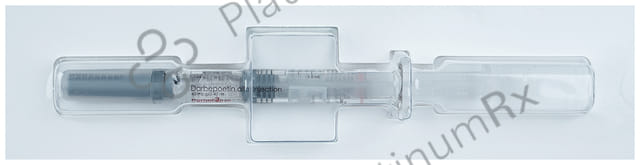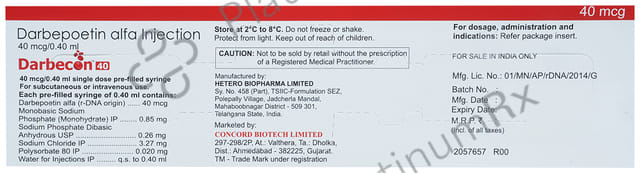




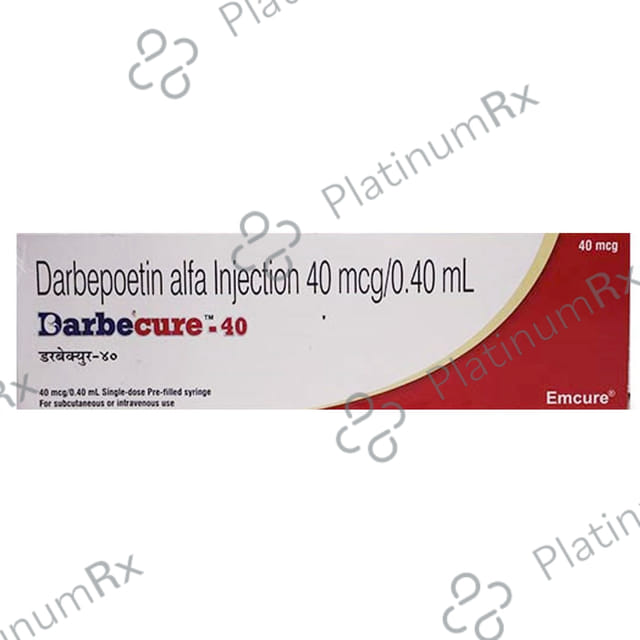
Darbecure 40mcg Injection 0.4ml

atom-spiralsSalt Composition:Darbepoetin alfa 40mcg

Darbecure 40mcg Injection 0.4ml is a prescription injection used to treat anaemia, which means having fewer red blood cells than normal. It is a man-made, long-acting form of erythropoietin, a natural hormone made mainly by the kidneys that tells the bone marrow to make red blood cells. Its single active ingredient belongs to a group of medicines called erythropoiesis-stimulating agents (ESAs), which are medicines that boost red blood cell production. Doctors use Darbecure 40mcg Injection 0.4ml for anaemia linked to long-term kidney disease, both in people on dialysis (treatment that cleans the blood when the kidneys cannot) and in those not on dialysis. It is also used for anaemia caused by certain types of chemotherapy. Its main purpose is to lower the need for red blood cell transfusions.

Read more

Written by: Srishti Bhukta, B. Pharma

Reviewed by: Dr. Varinderjeet Kaur, MBBS

Last updated on: 26-09-2026
Same Composition
Same Strength
FDA Approved
Same Composition
Currently Viewing
Darbecure 40mcg Injection 0.4ml

See affordable match

Top Substitute
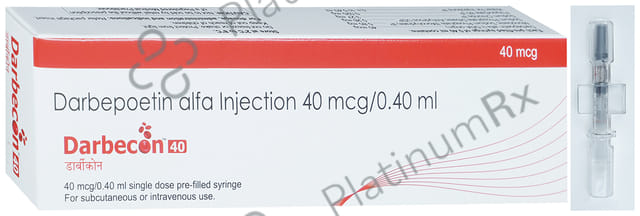
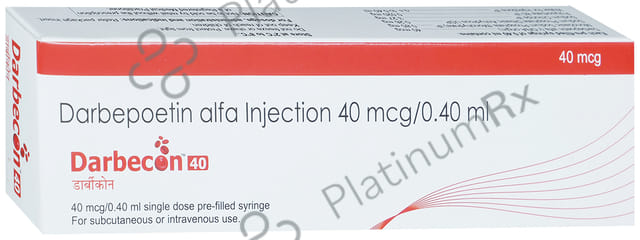
Darbecon 40mcg Injection 0.4ml

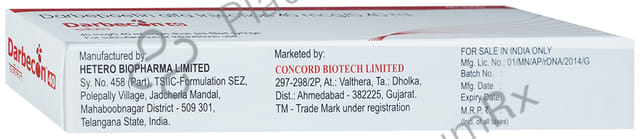
Concord Biotech Ltd.

Prefilled syringe of 0.4 ml
2.1K Bought this instead

Delivery by

...

FDA & GMP Certified

Long Expiry (>8 Months)

Medicine Comparison

100% Exact Salt Match
Darbecure 40mcg Injection 0.4ml
Darbecon 40mcg Injection 0.4ml
FDA Approved
FDA Approved
₹5,857 / Unit
₹4,395 / Unit

Have a question?

Doctor Approved & Trusted
thumbnail

Genuine Medicine

Pay On Delivery

Secure Payment

LegitScript Certified

LegitScript Certified Online Pharmacy

More About Darbecure 40mcg Injection 0.4ml

Detailed Description

Red blood cells carry oxygen around the body. Their production is controlled by erythropoietin, a hormone made mostly by the kidneys, with the liver as a smaller source. Darbecure 40mcg Injection 0.4ml works in the same way as this natural hormone. It signals the bone marrow, the soft tissue inside bones where blood cells are made, to produce more red blood cells.

Darbecure 40mcg Injection 0.4ml is a protein made up of 165 building blocks (amino acids). It carries extra sugar chains compared with natural erythropoietin. These small changes let it stay in the body longer. When given into a vein, it lasts about three times longer than epoetin alfa, an older medicine of the same type. Because of this, injections are spaced out, from once a week to once every few weeks, depending on the condition being treated.

Darbecure 40mcg Injection 0.4ml is used for two main situations:

  • Anaemia in adults and children with long-term (chronic) kidney disease, whether or not they are on dialysis.
  • Anaemia caused by chemotherapy that slows the bone marrow's production of blood cells, when at least two more months of chemotherapy are planned.

It is not meant for people with cancer who are only receiving hormone medicines, biologic medicines, or radiation. In people with cancer, it is also not used when chemotherapy is expected to clear the cancer completely or when the anaemia can be managed with transfusions. It is not a substitute for a transfusion when anaemia must be corrected right away. Darbecure 40mcg Injection 0.4ml has not been shown to improve quality of life, tiredness, or general well-being.

This medicine needs close medical supervision. Its US label carries a boxed warning. It states that medicines of this type raise the risk of death, heart attack, stroke, blood clots in the veins, clots in the dialysis access, and, in some cancers, tumour growth or return. In kidney disease, these risks were higher when treatment aimed for a haemoglobin (the oxygen-carrying part of red blood cells) level above 11 g/dL. Doctors therefore use the lowest dose that reduces the need for transfusions and check haemoglobin and iron levels regularly.

Composition

Darbecure 40mcg Injection 0.4ml is the only active ingredient. The US prescribing information describes it as a colourless liquid for injection that comes in two single-dose forms:

  • Single-dose vials - 25 mcg, 40 mcg, 60 mcg, 100 mcg, and 200 mcg
  • Single-dose prefilled syringes - 10 mcg, 25 mcg, 40 mcg, 60 mcg, 100 mcg, 150 mcg, 200 mcg, 300 mcg, and 500 mcg

Uses of Darbecure 40mcg Injection 0.4ml

  1. Anaemia from chronic kidney disease, in people on dialysis - Darbecure 40mcg Injection 0.4ml treats anaemia in adults and children whose kidney disease needs dialysis.
  2. Anaemia from chronic kidney disease, in people not on dialysis - It is also used for adults and children with long-term kidney disease who are not yet on dialysis.
  3. Anaemia caused by chemotherapy - It treats anaemia caused by chemotherapy that slows the bone marrow, when at least two more months of chemotherapy are planned.

Not used for

  • Anaemia in people with cancer who are only receiving hormone medicines, biologic medicines, or radiation
  • Anaemia during chemotherapy that is expected to clear the cancer completely
  • Anaemia that needs to be corrected right away, in place of a transfusion

Benefits of Darbecure 40mcg Injection 0.4ml

  1. Fewer blood transfusions - Darbecure 40mcg Injection 0.4ml raises red blood cell production so that fewer transfusions are needed.
  2. Less frequent injections - It stays in the body longer than epoetin alfa, so doses can be spaced from weekly up to once every 4 weeks, depending on the condition.
  3. Two ways to give it - For kidney-related anaemia, it can be given into a vein, which suits people on haemodialysis, or under the skin.
  4. Option of home use - After proper training, patients or caregivers can give the injection at home.
  5. Studied in children with kidney disease - It has been shown to be safe and effective in children with chronic kidney disease from 1 month to 16 years of age.

Side Effects of Darbecure 40mcg Injection 0.4ml

Common Side Effects (Usually Mild)

In studies of people with chronic kidney disease, the most common side effects were:

  • High blood pressure (hypertension), in about 31% of people. This can become serious, so your blood pressure will be checked regularly and you may need blood pressure medicine.
  • Shortness of breath, in about 17%
  • Swelling of the arms or legs (oedema), in about 17%
  • Cough, in about 12%
  • Low blood pressure during dialysis, in about 10%

In studies of people with cancer receiving chemotherapy, these were reported more often with Darbecure 40mcg Injection 0.4ml:

  • Stomach pain, in about 13%
  • Swelling (oedema), in about 13%

Other side effects include:

  • Redness, swelling, bruising, itching, or a lump where the injection was given

Serious Side Effects (Seek Urgent Medical Attention)

  • Blood clots, heart attack, and stroke - Signs include pain or swelling in a leg, chest pain, shortness of breath, sudden trouble speaking, or sudden weakness.
  • Seizures (fits) - Darbecure 40mcg Injection 0.4ml raises the risk of seizures in people with chronic kidney disease.
  • Hypertensive encephalopathy - This means the brain is affected by very high blood pressure. It has been reported along with seizures in people using this medicine.
  • Pure red cell aplasia (PRCA) - This is a rare condition in which the body makes antibodies against erythropoietin and the bone marrow almost stops making red blood cells, causing severe anaemia. It has mostly been reported in people with kidney disease who received this type of medicine under the skin. Signs can include extreme tiredness, lack of energy, dizziness, fainting, and pale skin.
  • Serious allergic reactions (anaphylaxis) - Signs include rash, hives, itching, wheezing, trouble breathing or swallowing, hoarseness, and swelling of the face, throat, tongue, lips, or eyes (angioedema).
  • Stevens-Johnson syndrome (SJS) and toxic epidermal necrolysis (TEN) - These are rare but severe skin reactions that cause blistering and peeling of the skin. Erythema multiforme, another blistering skin reaction, has also been reported. Treatment is stopped straight away if one of these is suspected.
  • Tumour growth or shorter survival in some cancers - This was seen in studies of people with breast cancer, non-small cell lung cancer (a type of lung cancer), head and neck cancer, lymphoid cancers (cancers of the lymph system, such as lymphoma), and cervical cancer (cancer of the neck of the womb).

Directions for Use

  • Darbecure 40mcg Injection 0.4ml is given as an injection, either under the skin (subcutaneous) or into a vein (intravenous). It is not taken by mouth.
  • For people on haemodialysis (dialysis using a machine that filters the blood), the vein route is recommended. For people receiving chemotherapy, it is injected under the skin.
  • Many people receive it at a clinic or dialysis unit. Some patients or caregivers are trained to give the injection at home. If you inject at home, follow the Instructions for Use exactly and ask your care team to check your technique.
  • Injections are usually given once every 1 to 4 weeks, as your doctor decides. Keep to the same schedule and mark injection dates on a calendar so a dose is not missed.
  • Do not shake the vial or syringe. Do not use it if it has been shaken or frozen.
  • Do not mix Darbecure 40mcg Injection 0.4ml with other medicines or dilute it.
  • Use a different injection site each time.
  • Each vial or prefilled syringe is for one use only. Never reuse needles, syringes, or leftover medicine, and throw away used items safely.
  • The needle cover of the prefilled syringe contains dry natural rubber, which comes from latex. Tell your doctor if you are allergic to latex.
  • Because it is an injection, you do not need to time it around meals.
  • Keep using Darbecure 40mcg Injection 0.4ml for as long as your doctor prescribes and do not stop without talking to them. For anaemia from chemotherapy, it is stopped once the chemotherapy course is finished.

How it works

Darbecure 40mcg Injection 0.4ml works in the same way as the body's own erythropoietin. It attaches to receptors, which are like docking points, found on early blood-forming cells in the bone marrow. This sets off a chain of signals inside those cells. The signals switch on genes that help the cells grow and multiply, and that stop them from dying too early. More of these early cells then go on to become red blood cells.

Compared with natural erythropoietin, Darbecure 40mcg Injection 0.4ml has extra sugar chains attached to it. These make the medicine last longer in the bloodstream, which is why it can be given less often. The effect builds slowly. A rise in haemoglobin, the oxygen-carrying part of red blood cells, is usually not seen until 2 to 6 weeks after treatment starts.

Safety Advice for Darbecure 40mcg Injection 0.4ml

icon
Pregnancy
Limited information

There is too little information on use during pregnancy to know whether Darbecure 40mcg Injection 0.4ml raises the risk of birth defects or miscarriage. In a rat fertility study, early pregnancy loss increased at doses similar to human starting doses, but studies in pregnant rats and rabbits during organ development showed no harm to the unborn young. Tell your doctor if you are pregnant or planning a pregnancy so they can weigh the benefits for you against possible risks to the baby.

icon
Breastfeeding
Limited information

It is not known whether Darbecure 40mcg Injection 0.4ml passes into breast milk or affects a breastfed baby or milk supply. Your doctor will weigh the benefits of breastfeeding against your need for treatment.

icon
Alcohol
Limited information

Ask your doctor whether alcohol is okay for you. Keeping blood pressure under control is a key part of safe treatment with Darbecure 40mcg Injection 0.4ml.

icon
Driving
Limited information

Seizures have been reported in people with kidney disease using Darbecure 40mcg Injection 0.4ml, and dizziness or fainting can be signs of a serious side effect. Do not drive if you have any of these symptoms, and talk to your doctor first.

icon
Kidney
Limited information

Darbecure 40mcg Injection 0.4ml is mainly used for anaemia in chronic kidney disease. People with kidney disease have a higher risk of seizures with this medicine. Aiming for a haemoglobin level above 11 g/dL raised the risk of heart problems and stroke. People on dialysis may need changes to their dialysis plan.

icon
Liver
Limited information

The prescribing information gives no separate advice for people with liver disease. Tell your doctor if you have liver disease so it can be taken into account along with your other health conditions and blood test results.

icon
Children
Limited information

Darbecure 40mcg Injection 0.4ml has been shown to be safe and effective in children with chronic kidney disease aged 1 month to 16 years, on or off dialysis, with results similar to adults. It has not been shown to be safe and effective in children with cancer.

icon
Elderly patients
Limited information

In studies, no differences in safety or effectiveness were seen between older and younger adults.

icon
Allergy
Limited information

Do not use Darbecure 40mcg Injection 0.4ml if you have had a serious allergic reaction to it. The needle cover of the prefilled syringe contains dry natural rubber, which comes from latex and may cause allergic reactions. Tell your doctor if you are allergic to latex.

Quick Tips for Darbecure 40mcg Injection 0.4ml

  • Get your blood pressure checked regularly and take your blood pressure medicines exactly as prescribed.
  • Go for your haemoglobin blood tests. They are usually done every week after starting treatment and after any dose change, until your level is stable.
  • Your doctor will check your iron levels before and during treatment and may prescribe iron supplements.
  • Tell your doctor straight away about any new seizure, or a change in how often you have seizures.
  • Tell your doctor before any surgery, especially heart bypass surgery or bone surgery.
  • Let the laboratory staff know that you are using Darbecure 40mcg Injection 0.4ml before any blood test.
  • Keep a written list of all the medicines you take and show it to every doctor you see.
  • Keep the medicine in its carton in the fridge, and never shake it.

Storage Advice

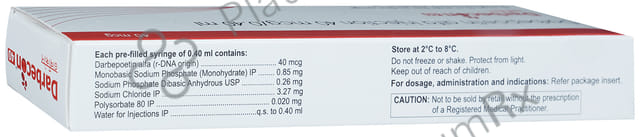
  • Store in a refrigerator between 2°C and 8°C (36°F and 46°F).
  • Do not freeze. Do not use Darbecure 40mcg Injection 0.4ml if it has been frozen.
  • Do not shake. Do not use it if it has been shaken.
  • Keep it in its original carton until use to protect it from light.
  • Single-dose vials and prefilled syringes are for one use only. Throw them away after use, even if some medicine is left.
  • Keep it out of reach of children and pets.
  • Do not flush unused medicine down the toilet. Use a medicine take-back programme or ask your pharmacist how to dispose of it, and put used needles in a puncture-proof container.

Drug-Food Interaction

  • Darbecure 40mcg Injection 0.4ml is injected, so meals do not change how it enters the body and it does not need to be timed around food.
  • Your doctor may prescribe a special diet to help control your blood pressure and to increase your iron levels, since low iron can stop the medicine from working well.
  • The label asks patients to follow any recommended dietary restrictions, especially those that help keep blood pressure under control.
  • Ask your doctor whether alcohol is okay for you.

Interactions with Other Drugs

The prescribing information for Darbecure 40mcg Injection 0.4ml does not include a separate drug interactions section. The points below are practical cautions taken from its prescribing information.

  • Iron supplements - Iron is needed to make red blood cells. Doctors check iron levels before and during treatment and often prescribe iron alongside Darbecure 40mcg Injection 0.4ml. Low iron is one of the reasons the medicine may not work well.
  • Heparin (used during haemodialysis) - People using Darbecure 40mcg Injection 0.4ml may need more heparin to stop blood from clotting in the dialysis machine tubing.
  • Blood pressure medicines - In studies, about 40% of people with chronic kidney disease needed to start or increase blood pressure medicines while on Darbecure 40mcg Injection 0.4ml. Keep taking these exactly as prescribed.
  • Switching to another ESA (such as epoetin alfa) - If pure red cell aplasia develops, Darbecure 40mcg Injection 0.4ml is stopped for good and the person should not be switched to another medicine of this type.
  • Other injectable medicines - Do not mix Darbecure 40mcg Injection 0.4ml with other medicines in the same syringe or dilute it.
  • Tell your doctor about all prescription and non-prescription medicines, vitamins, and supplements you use.

Drug-Disease Interactions

  • Uncontrolled high blood pressure - Darbecure 40mcg Injection 0.4ml must not be used if blood pressure is not under control. Blood pressure should be controlled before and during treatment.
  • Past pure red cell aplasia - It must not be used in people who developed PRCA after using Darbecure 40mcg Injection 0.4ml or another erythropoietin medicine.
  • Past serious allergy to Darbecure 40mcg Injection 0.4ml - It must not be used.
  • Heart disease or past stroke - Medicines of this type raise the risk of heart attack, stroke, and blood clots. Tell your doctor about any heart problems or past stroke.
  • Seizures - Tell your doctor if you have ever had a seizure. The risk of seizures is higher in people with kidney disease.
  • Cancer - Medicines of this type have been linked to tumour growth or return and shorter survival in some cancers. If you are using Darbecure 40mcg Injection 0.4ml for kidney-related anaemia, tell your doctor if you have or have had cancer.
  • Planned surgery - Tell your doctor if you are due to have surgery, especially heart bypass or bone surgery.
  • Latex allergy - The prefilled syringe needle cover contains a latex-derived material that may cause allergic reactions.
  • Infection, inflammation, bleeding, or iron deficiency - These can stop Darbecure 40mcg Injection 0.4ml from working well, so your doctor will look for them if your haemoglobin does not rise as expected.

Daily Dose

Darbecure 40mcg Injection 0.4ml is not a daily medicine. It is injected once every 1 to 4 weeks, depending on the condition and your doctor's plan. It is not given more often than your doctor has scheduled.

The US prescribing information lists these starting doses, worked out by body weight or as a fixed amount:

  • Chronic kidney disease, on dialysis (adults) - 0.45 mcg per kg once a week, or 0.75 mcg per kg once every 2 weeks, into a vein or under the skin.
  • Chronic kidney disease, not on dialysis (adults) - 0.45 mcg per kg once every 4 weeks, into a vein or under the skin.
  • Chronic kidney disease (children) - 0.45 mcg per kg once a week. Children not on dialysis may also start at 0.75 mcg per kg once every 2 weeks.
  • Anaemia from chemotherapy (adults) - 2.25 mcg per kg under the skin once a week, or 500 mcg under the skin once every 3 weeks.

Treatment is usually started only when haemoglobin is below 10 g/dL. Haemoglobin is checked every week until it is stable and then at least once a month.

Your doctor then adjusts the dose based on your haemoglobin results, using the lowest dose that reduces the need for transfusions. Always use the dose and schedule your doctor prescribes. Do not change it yourself.

Overdose

Too much Darbecure 40mcg Injection 0.4ml can push haemoglobin above the level your doctor is aiming for. Severe high blood pressure has been seen after overdose with medicines of this type. Doctors manage an overdose by stopping or lowering the dose, and sometimes by removing some blood (phlebotomy). Supportive care for high blood pressure may also be given.

If you think you or someone else has received too much, contact your doctor right away. If the person has collapsed, had a seizure, has trouble breathing, or cannot be woken, go to the nearest emergency department immediately. Take the medicine carton with you.

What If You Forget to take Darbecure 40mcg Injection 0.4ml?

If you miss a dose of Darbecure 40mcg Injection 0.4ml, call your doctor right away and ask what to do. Do not give yourself a double dose to make up for the one you missed. Because doses are spaced days or weeks apart, your doctor will tell you when to have the missed dose and when the next one is due.

When to contact doctor

Get emergency medical help right away if you notice:

  • Chest pain
  • Shortness of breath or trouble breathing
  • Pain or swelling in a leg
  • Sudden trouble speaking or sudden weakness
  • A seizure (fit), or a change in how often you have seizures
  • Swelling of the face, lips, tongue, or throat, wheezing, or trouble swallowing
  • Blistering or peeling skin, or a widespread rash
  • Fainting

Call your doctor soon if you have:

  • Very high blood pressure readings at home
  • Extreme tiredness, lack of energy, dizziness, or pale skin, which can be signs of severe anaemia
  • Swelling of the hands, feet, ankles, or lower legs
  • Redness, swelling, or lumps at the injection site that do not go away

FAQ

Fact Box

Therapeutic Class

Anti-anaemia medicine (haematopoietic agent)

Action Class

Erythropoiesis-stimulating agent (ESA)

Chemical Class

Recombinant glycoprotein (modified form of human erythropoietin)

Habit Forming

No

Disclaimer

PlatinumRx is committed to providing reliable and accurate information to support informed customer decisions. However, all information made available on the Platform, including product descriptions, comparisons, and other content, is provided solely for general informational purposes. Such information is not intended to diagnose, prevent, treat, or cure any medical condition, nor should it be relied upon as a substitute for professional medical advice, diagnosis, or treatment.

View More
editorial-png
Authentic & trustworthy information
Having issues with the content?
Report Error

Customers also bought