100% Same
Salt CompositionMedicine UsageStrength

Top Branded
Substitute
 Salt Composition in both





WHO GMP
Certified

15 Days Easy
Returns

Long Expiry
(>8 Months)

WHO GMP
Certified

15 Days Easy
Returns

Long Expiry
(>8 Months)

Delivery by
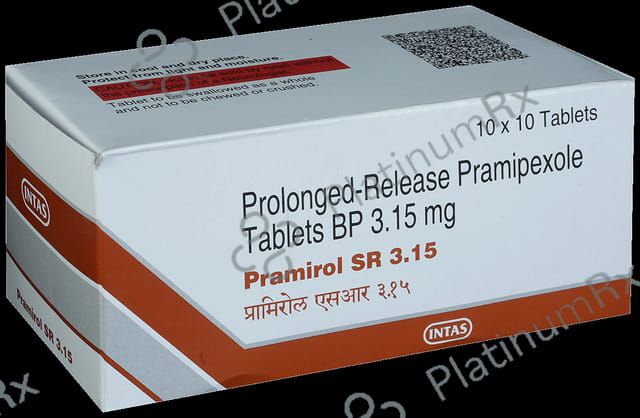
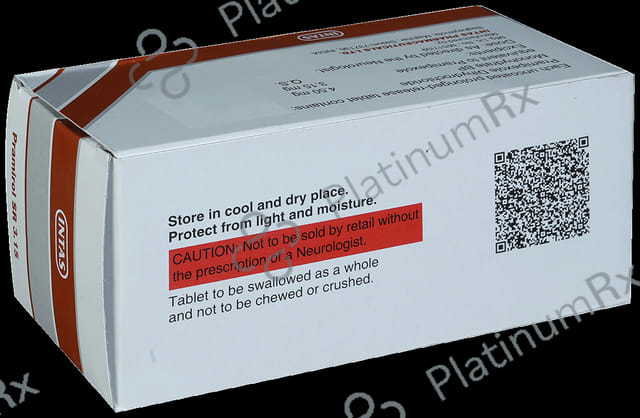
Uses of Prarimol 3.15mg Tablet SR

Parkinson's disease / Restless leg syndrome
Customers also bought

More About Prarimol 3.15mg Tablet SR
Quick Summary
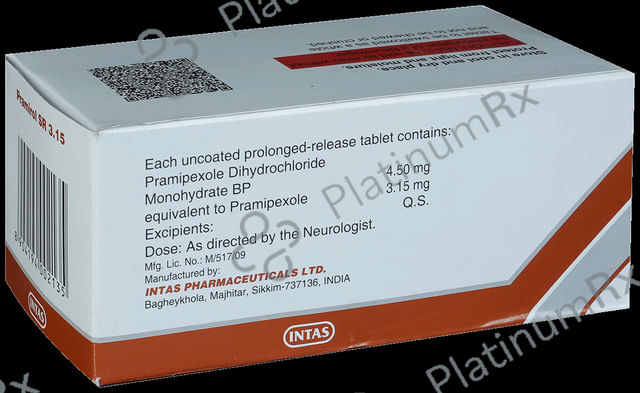
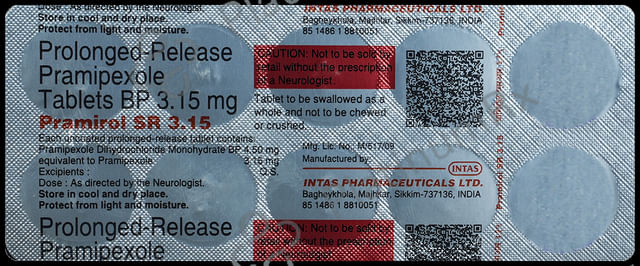
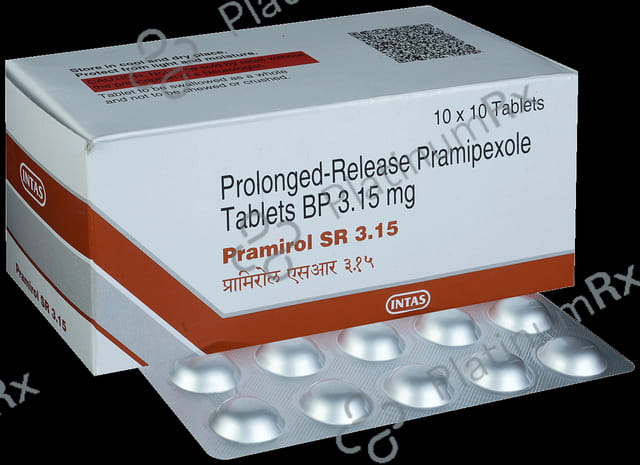
Prarimol 3 15mg Tablet Sr contains Pramipexole and is used to treat signs and symptoms of Parkinson's disease, such as stiffness, tremors, and slowed movement. It is also prescribed for moderate-to-severe primary restless legs syndrome (RLS), a condition causing uncomfortable sensations in the legs and an irresistible urge to move them, typically worsening at night. The medicine mimics dopamine in the brain, helping to improve muscle control and reduce abnormal movements. By activating dopamine receptors, Prarimol 3 15mg Tablet Sr supports smoother mobility and better sleep for those affected. Prarimol 3 15mg Tablet Sr is usually prescribed for patients where symptoms significantly impact daily life and non-drug treatments have not been sufficient.
Detailed Description
Prarimol 3 15mg Tablet Sr works by mimicking dopamine activity in the brain to improve movement control and reduce restlessness. After it is taken by mouth, the medicine is quickly absorbed and crosses into the brain, where it directly stimulates dopamine receptors responsible for its therapeutic effect.
The active form of Prarimol 3 15mg Tablet Sr acts on specific D2 and D3 dopamine receptors in the basal ganglia, helping restore smooth muscle coordination. This receptor stimulation improves nerve signaling between the substantia nigra and striatum, reducing tremors, stiffness, and slowness characteristic of Parkinson's disease. For restless legs syndrome, it calms overactive sensory pathways in the spinal cord that trigger uncomfortable leg sensations during rest.
This medicine is particularly helpful for people whose brains produce insufficient dopamine due to Parkinson's disease progression or have circadian rhythm disruptions causing restless legs syndrome. This can occur in early Parkinson's before levodopa necessity, advanced Parkinson's motor fluctuations, or primary/secondary RLS. In these cases, the normal dopamine signaling that coordinates movement and sensory comfort is weakened or absent. Prarimol 3 15mg Tablet Sr helps replace this missing response, allowing people to move and rest more comfortably.
The effects of Prarimol 3 15mg Tablet Sr usually begin within one to two hours after taking a dose. Because of this predictable timing, many patients take it before activities requiring fine motor skills or at bedtime for RLS. The medicine mainly acts on dopamine pathways in the brain and does not significantly affect blood pressure, which helps reduce cardiovascular side effects.
Prarimol 3 15mg Tablet Sr is removed from the body primarily through the kidneys, so healthcare providers may adjust the dose in people with kidney problems. When used as prescribed, it is considered an effective and reliable treatment for people with Parkinson's disease or restless legs syndrome that interferes with daily life.
Uses of Prarimol 3 15mg Tablet Sr
Parkinson's Disease
Management of motor symptoms like tremors, rigidity, and slowness in early to advanced stages.
Restless Legs Syndrome
Treatment of moderate-to-severe primary RLS to reduce leg discomfort and urge to move.Adjunct Therapy: Combined with levodopa in advanced Parkinson's to smooth fluctuations in symptom control.
Benefits of Prarimol 3 15mg Tablet Sr
- Improved Motor Function: Enhances mobility by boosting dopamine signalling, reducing "off" time in Parkinson's patients.
- Better Sleep Quality: Effectively controls RLS symptoms at night, minimising disruptions and fatigue.
- Flexible Dosing for 1mg: The 1mg strength allows precise titration, starting low to optimise tolerance in sensitive patients.
- Neuroprotective Potential: Some evidence suggests it may slow Parkinson's progression via antioxidant effects.
- Fewer Peak-Dose Dyskinesias: Compared to levodopa, it causes fewer involuntary movements at therapeutic doses.
Side Effects of Prarimol 3 15mg Tablet Sr
When taken as directed, Prarimol 3 15mg Tablet Sr at 1mg is generally well-tolerated, but side effects can occur, especially during initiation or dose increases.
Common Side Effects
- Nausea or Vomiting: Often mild and decreases with time or food intake.
- Dizziness or Drowsiness: May cause sudden sleep episodes; avoid driving if affected.
- Fatigue: General tiredness, particularly early in treatment.
Uncommon Side Effects
- Hallucinations: Visual or auditory, more in elderly Parkinson's patients.
- Orthostatic Hypotension: Drop in blood pressure upon standing.
- Constipation: Due to dopamine effects on gut motility.
Serious Side Effects (Require Immediate Medical Attention)
- Impulse Control Disorders: Pathological gambling, binge eating, or hypersexuality.
- Severe Allergic Reactions: Rash, swelling, or breathing difficulty.
- Neuroleptic Malignant Syndrome: Rare high fever, muscle rigidity if stopped abruptly.
Directions for Use
Prarimol 3 15mg Tablet Sr should be taken exactly as prescribed by your physician. For Parkinson's disease, the 1mg tablet is typically taken three times daily, with doses spaced 4-6 hours apart during waking hours; for restless legs syndrome (RLS), take a single 1mg dose 2-3 hours before bedtime.
Tablets should be swallowed whole with water, with or without food, to help reduce nausea.
How it Works
The mechanism of Prarimol 3 15mg Tablet Sr centres on its role as a selective dopamine agonist, primarily targeting D2 and D3 receptors in the brain. After oral intake, it directly binds to these receptors without needing conversion, stimulating dopamine pathways in the basal ganglia to improve motor function in Parkinson's and suppress sensory symptoms in RLS. This activation enhances neuronal signalling, reducing tremors, rigidity, and the urge to move legs by restoring dopaminergic balance.
Safety Advice for Prarimol 3 15mg Tablet Sr

ALCOHOL
AVOID
Alcohol worsens dizziness/sleepiness. Increases fall risk significantly; avoid completely during treatment.

PREGNANCY
CONSULT YOUR DOCTOR
Limited safety data. Use only if benefits outweigh risks; discuss alternatives with neurologist.

BREASTFEEDING
CONSULT YOUR DOCTOR
May inhibit milk production. Monitor infant for sedation; discuss formula options if needed.

DRIVING
CAUTION
May cause sudden sleep attacks. Don't drive until stable on dose 2 weeks; inform DVLA/MVD.

LIVER
CONSULT YOUR DOCTOR
Use cautiously with impairment. Requires dose adjustment; monitor for excessive sleepiness.

KIDNEY
MONITOR CLOSELY
Reduced clearance in kidney disease. Requires dose adjustment; regular kidney tests needed.
FOOD
NO INTERACTION
Take consistently with/without food. Nausea reduced if taken with light meal initially.
LIFESTYLE
CAUTION
Expect sleepiness first 4 weeks. Rise slowly from sitting. Report hallucinations/impulse control issues immediately. Avoid gambling activities.
Quick Tips for Prarimol 3 15mg Tablet Sr
- Slow Titration Rule: Start Prarimol 3 15mg Tablet Sr at a low dose like 0.125mg and increase gradually every 5-7 days to 1mg to minimise nausea and hallucinations.
- Take with Food: Consume Prarimol 3 15mg Tablet Sr 1mg with meals to reduce gastrointestinal upset, a common issue during initiation.
- Avoid Alcohol: Limit or avoid alcohol, as it heightens risks of drowsiness and sudden sleep onset with Prarimol 3 15mg Tablet Sr.
- Monitor Impulse Control: Watch for new gambling, shopping, or binge eating behaviours; report immediately, especially at 1mg doses.
- Sudden Sleep Warning: Prarimol 3 15mg Tablet Sr may cause irresistible sleepiness; do not drive until effects are known.
Drug-Food Interaction
While Prarimol 3 15mg Tablet Sr absorption is unaffected by most foods, certain items can exacerbate side effects at the 1mg dose. Take consistently with food to steady levels.
- High-Fat Meals (Moderate): May delay absorption slightly; consistent timing prevents peak fluctuations leading to dizziness.
- Alcohol (High): Amplifies sedation and orthostatic hypotension; avoid to prevent falls or accidents.
- Tyramine-Rich Foods (Low): Limit aged cheeses or cured meats if on higher doses, though less risky at 1mg than other agonists.
Interactions with Other Drugs
Prarimol 3 15mg Tablet Sr at 1mg interacts with drugs affecting dopamine or sedation, potentially intensifying effects.
- Antipsychotics (High): Dopamine blockers like haloperidol antagonise Prarimol 3 15mg Tablet Sr, reducing efficacy.
- Sedatives/Opioids (High): Additive drowsiness with benzodiazepines or opioids; avoid combinations.
- Levodopa (Moderate): Enhances effects in Parkinson's but increases dyskinesia risk; titrate carefully.
- CYP1A2 Inhibitors (Moderate): Drugs like ciprofloxacin raise Prarimol 3 15mg Tablet Sr levels; monitor for toxicity.
Drug-Disease Interactions
Prarimol 3 15mg Tablet Sr requires caution in certain conditions due to its dopamine effects, particularly at 1mg, where CNS impacts are notable.
- Psychotic Disorders (High): Worsens hallucinations or delusions; contraindicated in active psychosis. Renal Impairment (High): Reduce dose in moderate-severe kidney disease, as clearance drops, risking accumulation at 1mg.
- Cardiovascular Disease (Moderate): May exacerbate hypotension or arrhythmias; monitor closely in heart failure.
- Sleep Disorders (Moderate): Heightens somnolence in patients with narcolepsy or similar conditions.
What If You Forget to take Prarimol 3 15mg Tablet Sr?
If you miss a dose of Prarimol 3 15mg Tablet Sr, take it as soon as you remember unless it's almost time for your next dose, in which case, skip the missed one and resume your regular schedule. Never double up on doses to make up for a missed one, as this can increase side effects like drowsiness or nausea; for RLS, simply skip the evening dose if forgotten.
Fact Box
Therapeutic Class
Antiparkinsonian Agent
Action Class
D2/D3 Receptor Agonist
Chemical Class
Non-Ergoline Dopamine Agonist
Habit Forming
No


Disclaimer
PlatinumRx is committed to providing reliable and accurate information to support informed customer decisions. However, all information made available on the Platform, including product descriptions, comparisons, and other content, is provided solely for general informational purposes. Such information is not intended to diagnose, prevent, treat, or cure any medical condition, nor should it be relied upon as a substitute for professional medical advice, diagnosis, or treatment.
More Medicines By Manufacturer
More Medicines With Salt
Top Selling Medicines
Top Selling Devices
Flat ₹100 off on first app order | Use Code: APP100 |
Flat ₹100 off on first app order
USE CODE: APP100

Download Now


