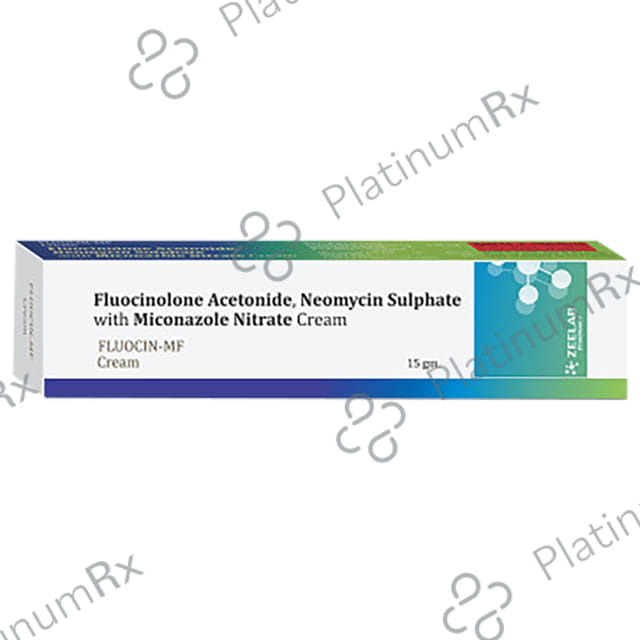
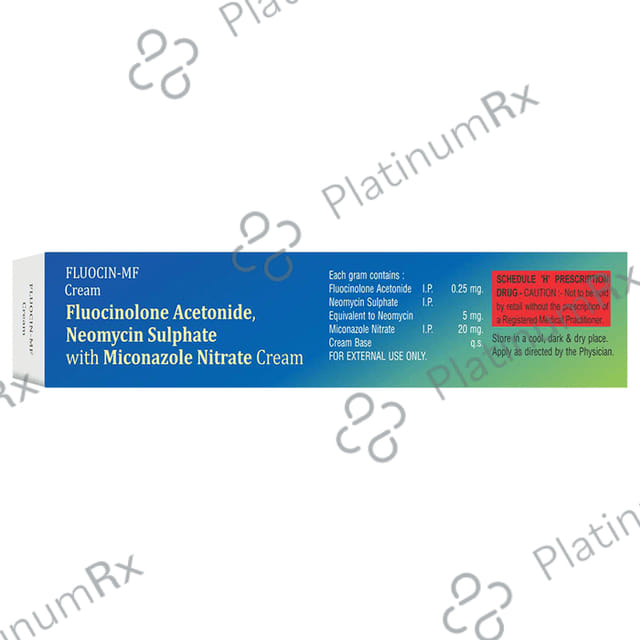
Fluocin MF Cream 15gm

Fluocin MF Cream 15gm is a topical triple-action combination used for inflamed skin conditions complicated by bacterial and fungal infection. It contains fluocinolone acetonide, a medium-potency topical corticosteroid that reduces inflammation, redness, and itching; miconazole, a broad-spectrum imidazole antifungal effective against dermatophytes and Candida; and neomycin, an aminoglycoside antibiotic active against many gram-positive and gram-negative skin pathogens. The combination is applied for short courses to manage mixed-aetiology dermatoses (conditions affecting skin, nails & hair) where inflammation is present and coexists with superficial infection.
FDA & GMP Certified
Long Expiry (>8 Months)
15 Days Easy Returns
General Information
Have a question?

Genuine Medicine
Pay On Delivery
Secure Payment

LegitScript Certified Online Pharmacy


More About Fluocin MF Cream 15gm
Quick Summary
Fluocin MF Cream 15gm is a topical triple-action combination used for inflamed skin conditions complicated by bacterial and fungal infection. It contains fluocinolone acetonide, a medium-potency topical corticosteroid that reduces inflammation, redness, and itching; miconazole, a broad-spectrum imidazole antifungal effective against dermatophytes and Candida; and neomycin, an aminoglycoside antibiotic active against many gram-positive and gram-negative skin pathogens. The combination is applied for short courses to manage mixed-aetiology dermatoses (conditions affecting skin, nails & hair) where inflammation is present and coexists with superficial infection.
Detailed Description
Inflammatory skin conditions such as eczema, intertrigo, and contact dermatitis are often colonised or superinfected by bacteria and fungi, which can prolong symptoms and prevent healing. A single topical agent addressing only one component (inflammation, bacteria, or fungus) may leave the other unchecked.
Fluocinolone acetonide is a synthetic steroid that enters skin cells and attaches to specific receptors inside them. This switches off the chemicals that drive inflammation, calms overactive immune cells, and narrows small blood vessels in the area. All of this, together, reduces redness, swelling, and itching. Miconazole disrupts ergosterol synthesis in the fungal cell membrane, causing the membrane to become leaky and the fungus to die. It is active against dermatophytes (Trichophyton, Microsporum, Epidermophyton), Candida species, and Malassezia. Neomycin, an aminoglycoside, disrupts protein synthesis, providing topical antibacterial activity against several skin pathogens, including Staphylococcus aureus and many gram-negative organisms. Together, the three components address the inflammatory, fungal, and bacterial elements of mixed dermatoses.
Uses of Fluocin MF Cream 15gm
- To manage inflammatory skin conditions complicated by superficial bacterial and/or fungal infection, when both components are clinically suspected or confirmed.
- To manage infected eczema, infected contact dermatitis, and infected intertrigo, as directed.
- To relieve symptoms (itching, redness, scaling) in mixed-aetiology dermatoses under medical supervision.
Benefits of Fluocin MF Cream 15gm
- Targets three components of mixed skin disease (inflammation, fungus, bacteria) with a single topical application.
- Limits itching and redness rapidly with the help of the corticosteroid component.
- Limits superficial bacterial and fungal overgrowth that can perpetuate inflammation.
- Convenient single-product application improves adherence in short courses.
Side Effects of Fluocin MF Cream 15gm
Common
- Local burning, stinging, or itching at the application site
- Dryness, irritation, or mild redness
- Folliculitis (inflammation of hair follicles)
Uncommon
- Skin thinning (atrophy) with prolonged use
- Stretch marks (striae), telangiectasia (visible small vessels)
- Pigmentary changes (lightening or darkening of skin)
- Contact dermatitis to neomycin or other components
Serious side effects requiring immediate attention
- Spreading rash, blistering, or severe allergic reaction
- Changes in hearing
- Effects on the kidney from extensive application on broken skin (rare)
- Signs of HPA-axis suppression with long-term, large-area, or occluded use (fatigue, weight gain, mood changes)
Directions for Use
Before applying the medicine, wash and dry the affected area gently. Once done, apply a thin layer of Fluocin MF Cream 15gm to the affected skin once or twice daily or as advised by your doctor. Rub it in lightly. You should not bandage or cover it with airtight dressings unless your doctor specifically instructs you to. Avoid application of Fluocin MF Cream 15gm to the face, groin, or underarms unless directed. Do not use the medication on broken skin, ulcers, or large body surface areas for prolonged periods of time. Wash your hands after application unless your hands are the treatment site. Initially, you should use it for the shortest duration needed (usually up to 2 weeks), and consult with your doctor before reapplication.
How it works
Fluocinolone acetonide enters skin cells and binds to glucocorticoid receptors, switching off the genes that produce inflammatory cytokines and chemokines and switching on anti-inflammatory proteins. It reduces the migration of inflammatory cells into the skin, decreases capillary permeability, and dampens the itch–scratch cycle.
Miconazole inhibits the fungal enzyme 14α-demethylase, blocking conversion of lanosterol to ergosterol. Without ergosterol, the fungal cell membrane loses integrity, leaks essential contents, and the fungal cell dies. This action covers dermatophytes responsible for tinea infections as well as Candida and Malassezia involved in intertriginous and seborrhoeic flares.
Neomycin binds irreversibly to the 30S ribosomal subunit of susceptible bacteria, causing misreading of mRNA and delaying protein production. Because of this, the bacterium cannot make essential proteins and dies. Applied topically and used briefly, neomycin reduces bacterial load on inflamed or eroded skin.
Safety Advice for Fluocin MF Cream 15gm

Allergy
Unsafe
Avoid in known hypersensitivity to fluocinolone, miconazole, neomycin, other aminoglycosides, or any excipient.

Breastfeeding
Caution
Do not apply to the breast or nipple area before feeding. Use the smallest area for the shortest time.

Pregnancy
Caution
Use only if clearly needed; avoid large areas, occlusion, and prolonged use. Discuss with your doctor.

Driving
Safe
No known effect on alertness or driving.

Alcohol
Safe
No specific interaction with topical use.

Liver
Caution
Negligible systemic absorption with appropriate topical use.

Kidney
Caution
Avoid extensive use on broken skin; systemic neomycin absorption can be nephrotoxic and ototoxic.

Children
Caution
Use only as prescribed; children absorb topical steroids and neomycin more readily through thin skin.

Elderly patients
Caution
Thin, fragile skin increases the risk of atrophy and bruising.
Drug-Food Interaction
No clinically significant food interactions are reported with topical application.
Interactions with Other Drugs
- Other topical corticosteroids (CAUTION): Concurrent application increases the risk of skin atrophy and systemic steroid effects.
- Topical or systemic aminoglycosides (CAUTION): Additive ototoxicity and nephrotoxicity, particularly when used on large or broken skin areas.
- Loop diuretics such as furosemide (CAUTION): When meaningful systemic absorption of neomycin occurs, the combined ototoxic risk rises.
- Neuromuscular blockers (CAUTION): Systemically absorbed neomycin can potentiate neuromuscular blockade.
- Warfarin (CAUTION): Topical miconazole, especially on broken skin or with prolonged use, has been reported to increase INR (time taken to form a blood clot). Tell your doctor if you take warfarin.
Drug-Disease Interactions
- Untreated viral skin infections (CONTRAINDICATED): Topical corticosteroids can worsen or mask viral skin infections such as herpes simplex, varicella, or vaccinia.
- Tuberculous or syphilitic skin lesions (CONTRAINDICATED): Should not be applied to these lesions.
- Perforated tympanic membrane (CAUTION): Avoid use in or near the ear canal if the eardrum is perforated due to ototoxicity risk from neomycin.
- Large open wounds or burns (CAUTION): Increased systemic absorption of neomycin can cause nephrotoxicity or ototoxicity.
- Rosacea and perioral dermatitis (CAUTION): Topical corticosteroids may worsen these facial conditions.
Overdose
Topical overdose of Fluocin MF Cream 15gm is uncommon. Excessive or prolonged application over large areas, on broken skin, or under occlusion can lead to systemic effects such as HPA-axis suppression, Cushingoid features (moon face, central obesity with thin arms and legs, and reddish-purple stretch marks), ototoxicity (damage to the inner ear), or nephrotoxicity (damage to the kidneys due to exposure to drugs) from neomycin, and skin atrophy. If accidentally ingested or applied excessively, contact a healthcare professional.
What If You Forget to take Fluocin MF Cream 15gm?
If you miss an application, apply for it as soon as you remember on the same day. If it is close to the next scheduled application, skip the missed one and continue your routine. Do not apply extra to make up for a missed dose.
FAQ
References
- https://www.ncbi.nlm.nih.gov/books/NBK547820/
- https://www.ncbi.nlm.nih.gov/books/NBK470342/
- https://medlineplus.gov/druginfo/meds/a601054.html
- https://medlineplus.gov/druginfo/meds/a682289.html
- https://www.ncbi.nlm.nih.gov/books/NBK542250/
- https://www.cochranelibrary.com/cdsr/doi/10.1002/14651858.CD003871.pub3/full
Fact Box
Action Class
Topical anti-inflammatory, antifungal, and antibacterial combination
Chemical Class
Fluorinated topical corticosteroid; imidazole antifungal; aminoglycoside antibiotic
Habit Forming
No
Disclaimer
PlatinumRx is committed to providing reliable and accurate information to support informed customer decisions. However, all information made available on the Platform, including product descriptions, comparisons, and other content, is provided solely for general informational purposes. Such information is not intended to diagnose, prevent, treat, or cure any medical condition, nor should it be relied upon as a substitute for professional medical advice, diagnosis, or treatment.

Customers also bought





More Medicines By Zeelab Pharmacy Pvt. Ltd.
More Medicines With Fluocinolone acetonide 0.25mg + Miconazole 20mg + Neomycin 5mg
Top Selling Medicines
Top Selling Devices
Top Selling Health Products