


Chlorambucil
Uses
Chlorambucil is used in the treatment of blood cancer and Hodgkin's disease.
How it Works
How Chlorambucil works Chlorambucil is an anti-cancer medication that functions by damaging the genetic material, specifically DNA and RNA, of cancer cells. This action inhibits their growth and multiplication.
Side Effects
Common side effects of Chlorambucil include bone marrow suppression.
Expert Advice
- Chlorambucil should be taken one hour before a meal.
- Chlorambucil can also be taken two hours after a meal.
Top Selling Medicines
Top Health Products
Top Selling Devices
Dr. Morepen Gluco One BG-03 Test StripsAccu-Chek Instant Test StripsAccu-Chek Active Test StripsDr. Morepen BP-14 Blood Pressure MonitorAccu-Chek Active Test Strips 100sOneTouch Select Plus Test StripsDr. Morepen BG-03 GlucometerOneTouch Verio Test StripsAccu-Chek Instant S GlucometerAccu-Chek Active Test Strips 25sView More
Related Medications

Salt Composition
Chlorambucil 2mg
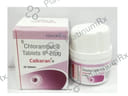
Celkeran 2mg Tablet 30s
Celon Laboratories Ltd.
Strip of 30 tablets
₹690.5
25% OFF
MRP ₹920.6
Salt Composition in both
Chlorambucil 2mg
Chloramax 2mg Tablet 30s
GLS Pharma Ltd.
Bottle of 30 tablets
MRP
₹1,424
Celkeran 2mg Tablet 30s
Celon Laboratories Ltd.
Strip of 30 tablets
₹690.5
MRP ₹920.6
52% OFF
Salt Composition in both
Chlorambucil 2mg
Clokeran 2 Tablet
Natco Pharma Ltd.
Strip of 30 tablets
MRP
₹900
Celkeran 2mg Tablet 30s
Celon Laboratories Ltd.
Strip of 30 tablets
₹690.5
MRP ₹920.6
23% OFF
Salt Composition in both
Chlorambucil 2mg
Leukeran 2mg Tablet 25s
GlaxoSmithKline Consumer Healthcare
Strip of 25 tablets
MRP
₹1,212.4
Celkeran 2mg Tablet 30s
Celon Laboratories Ltd.
Strip of 30 tablets
₹690.5
MRP ₹920.6
53% OFF
Salt Composition
Chlorambucil 5mg
Radix AQ 5mg Tablet 30s
GLS Pharma Ltd.
Strip of 30 tablets
MRP
₹2,370

Sorry, Substitute Medicine is Unavailable
Salt Composition
Chlorambucil 5mg
Chloramax 5mg Tablet 30s
GLS Pharma Ltd.
Bottle of 30 tablets
MRP
₹2,370
Sorry, Substitute Medicine is Unavailable
Salt Composition
Chlorambucil 5mg
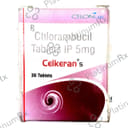
Celkeran 5mg Tablet
Celon Laboratories Ltd.
Strip of 30 tablets
MRP
₹2,324.5
Sorry, Substitute Medicine is Unavailable
Salt Composition
Chlorambucil 5mg
Clokeran 5mg Tablet
Natco Pharma Ltd.
Strip of 30 tablets
MRP
₹2,053.1
Sorry, Substitute Medicine is Unavailable