







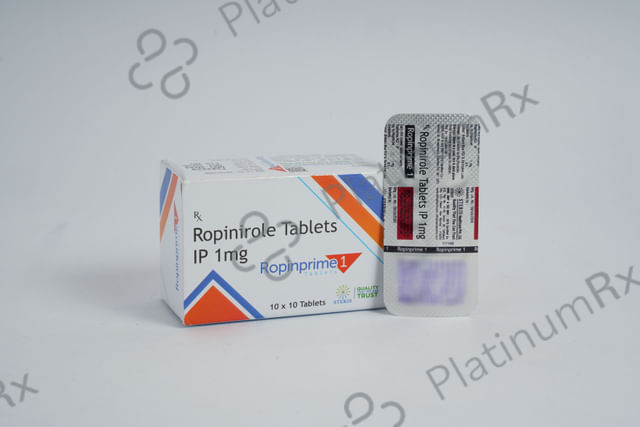
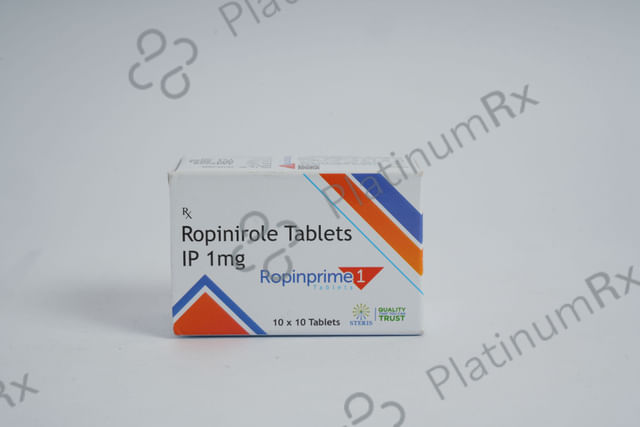
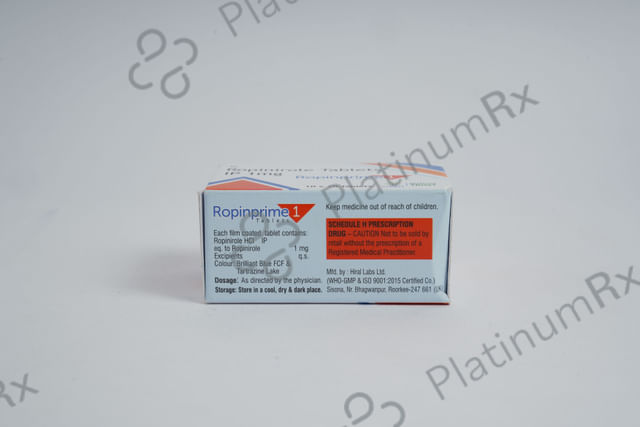
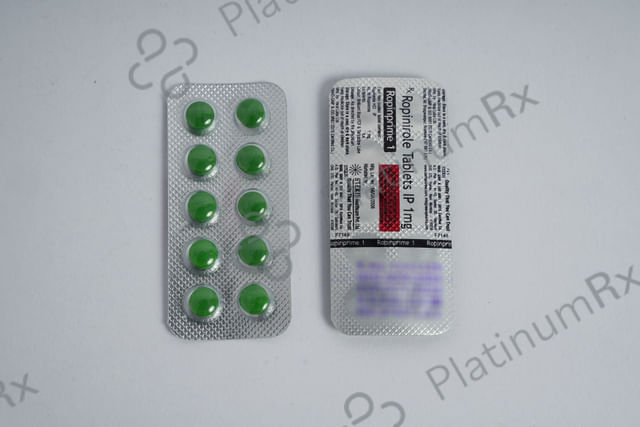
Ropark 1mg Tablet 10s
Sun Pharmaceutical Industries Ltd.
Strip of 10 tablets
₹174.66
₹213.00
18% Off
Ropitor 1mg Tablet is a medication used for the treatment of idiopathic Parkinson's disease (PD), both as monotherapy in early disease and as an addition to levodopa (gold standard medication used for the treatment of PD) in advanced disease. It is also used for moderate-to-severe primary Restless Legs Syndrome (RLS). It selectively stimulates dopamine D2 and D3 receptors in the brain, specifically in the striatum, partially compensating for the loss of dopamine-producing neurons in Parkinson's disease.
Written by: Shubham Kumar Singh, B pharmacy
Reviewed by: Dr. Jay Faldu, MBBS
Last updated on: 13-05-2026
Delivery by
...
FDA & GMP Certified
Long Expiry (>8 Months)
15 Days Easy Returns
Have a question?

Genuine Medicine
Pay On Delivery
Secure Payment

LegitScript Certified Online Pharmacy
View content in
 English
Ropitor 1mg Tablet is a medication used for the treatment of idiopathic Parkinson's disease (PD), both as monotherapy in early disease and as an addition to levodopa (gold standard medication used for the treatment of PD) in advanced disease. It is also used for moderate-to-severe primary Restless Legs Syndrome (RLS). It selectively stimulates dopamine D2 and D3 receptors in the brain, specifically in the striatum, partially compensating for the loss of dopamine-producing neurons in Parkinson's disease.
Ropinirole is a non-ergot agonist that is commonly prescribed for the management of Parkinson’s disease and Restless Leg Syndrome. The positive aspect about ropinirole is that it does not increase the risk of cardiac valvular fibrosis or pulmonary/retroperitoneal fibrosis, which is commonly seen in other ergot-derived agents.
In Parkinson's disease, Ropitor 1mg Tablet is used as initial monotherapy in early-stage disease, especially in younger patients who wish to delay the use of levodopa. It is also used as an adjunct in advanced disease to reduce the recurrence of symptoms when levodopa wears off (“off” time).
Unlike pramipexole (another medication used to treat PD & RLS), Ropitor 1mg Tablet is metabolised in the liver by CYP1A2, hence smokers and those on antibiotics may require dosage alteration. However, Ropitor 1mg Tablet avoids the motor fluctuations of long-term levodopa therapy and is often used as initial monotherapy in younger PD patients.
As monotherapy in early disease or as adjunctive therapy with levodopa in advanced disease.
Used to treat moderate-to-severe primary RLS.
Particularly useful in younger patients to delay the use of levodopa.
Always follow the dosage prescribed by your doctor. Take Ropitor 1mg Tablet orally exactly as prescribed. Generally, for Parkinson's disease, the immediate-release form is usually given in small quantities and is gradually titrated upwards weekly, typically in three divided doses. The extended-release form is taken once daily. For Restless Legs Syndrome, doses are much lower and are taken 1 to 3 hours before bedtime. Swallow tablets whole with water; do not crush or chew the extended-release tablets. May be taken with or without food, but taking it with food reduces nausea. Do not stop Ropitor 1mg Tablet abruptly, as withdrawal can precipitate dopamine agonist withdrawal syndrome or a neuroleptic malignant-like syndrome in PD patients. The medicine should always be tapered under medical supervision.
Parkinson's disease develops when dopamine-producing nerve cells in a part of the brain called the substantia nigra gradually die. Dopamine is a chemical messenger that helps the brain control smooth, coordinated movement. As dopamine levels fall, the brain's movement-control circuits stop working properly, leading to the main symptoms of Parkinson's disease, which include slowness of movement, muscle stiffness, tremor at rest, and unsteady balance
[Ropitor 1mg Tablet is a non-ergot dopamine agonist that directly stimulates dopamine receptors in the brain, bypassing the need for the body to produce its own dopamine. It selectively activates the D2 and D3 receptors, with minimal activity at D1, serotonin, adrenergic, or other receptors in the central nervous system.
By stimulating postsynaptic D2 and D3 receptors in the striatum (a deep brain nucleus), ropinirole partially restores dopamine signalling and improves motor function.
In Restless Legs Syndrome (RLS), the underlying problem involves disrupted dopamine signalling in the spinal and supraspinal pathways. Ropinirole activates dopamine receptors in these pathways, restoring normal sensory and motor signalling. This lowers the urge to move the legs and other unpleasant sensations of RLS.
Unlike levodopa, ropinirole:
Ropinirole is metabolised primarily by hepatic CYP1A2, which is induced by smoking and inhibited by ciprofloxacin and some other agents.

Consult your doctor to ensure the benefits outweigh the risks.

Suppresses prolactin, thereby reducing milk production. It can also be excreted into breast milk.

May cause sudden sleep attacks without warning, sleepiness, and orthostatic hypotension. Avoid driving until the response is known in your body.

Increased risk of sleepiness, additional sedation and falls.
Directly oppose ropinirole’s pharmacological effect. Hence, avoid taking them concurrently.
Significantly increase ropinirole levels (up to 100% increase with ciprofloxacin). Dose reduction required.
Reduces ropinirole levels by approx 30%. Adjust dose if smoking status changes.
Additional sedation and sleep-attack risk.
Additional risk of orthostatic hypotension.
Often co-prescribed, however, it may increase dyskinesias and hallucinations. Dose adjustment required.
May reduce ropinirole clearance. Consider dose adjustment.
Overdosing may result in severe nausea, vomiting, agitation, hallucinations, hypotension, drowsiness, dyskinesias, and, in severe cases, coma or convulsions. Management includes stabilising the airway, breathing, and circulation. Activated charcoal may be considered for recent ingestion. Intravenous fluids could be administered for hypotension, and non-dopamine antagonist sedatives to treat agitation or psychosis. Cardiac and neurological monitoring is required. Seek immediate emergency care if overdosing is suspected.
Take a missed dose as soon as you remember on the same day. If it is close to the time of the next dose, skip the missed dose and continue your normal schedule. Do not double-dose as it can increase the risk of nausea, dizziness, and orthostatic hypotension. In Parkinson's disease, missing doses can cause symptom recurrence. In RLS, a missed evening dose may result in symptom return that night. If you miss several doses, contact your doctor before resuming.
Therapeutic Class
Antiparkinsonian agent / dopamine agonist for Restless Legs Syndrome
Action Class
Non-ergot D2/D3 dopamine receptor agonist
Chemical Class
Indolone derivative; non-ergot dopamine agonist
Habit Forming
No (but impulse control disorders may develop)
PlatinumRx is committed to providing reliable and accurate information to support informed customer decisions. However, all information made available on the Platform, including product descriptions, comparisons, and other content, is provided solely for general informational purposes. Such information is not intended to diagnose, prevent, treat, or cure any medical condition, nor should it be relied upon as a substitute for professional medical advice, diagnosis, or treatment.

More Medicines By Torrent Pharmaceuticals Ltd.
More Medicines With Ropinirole 1mg
Top Selling Medicines
Top Selling Devices
Top Selling Health Products