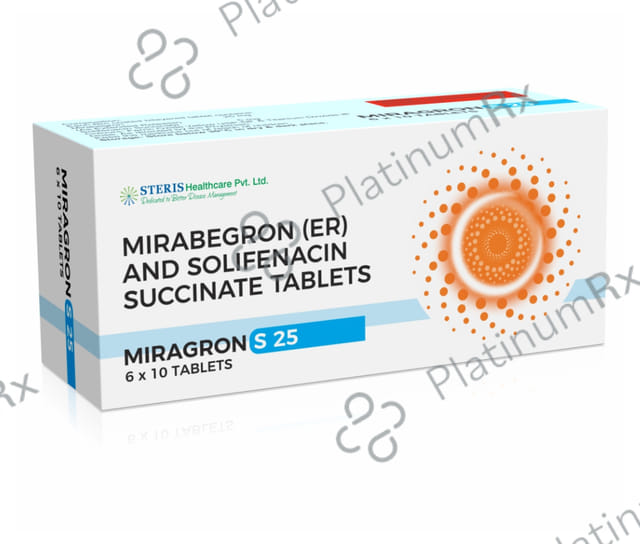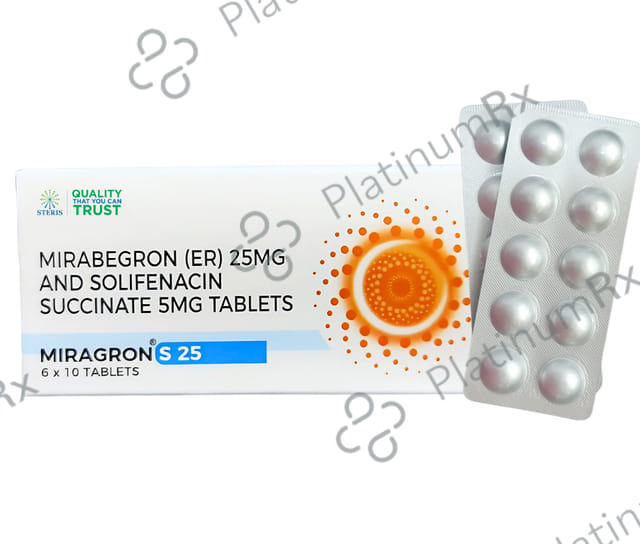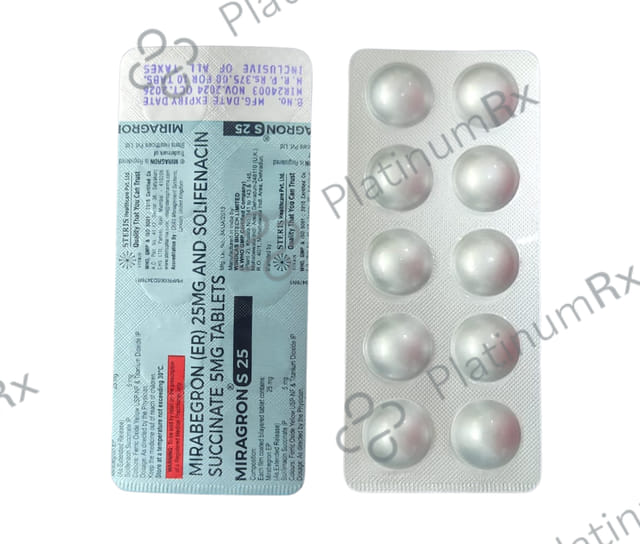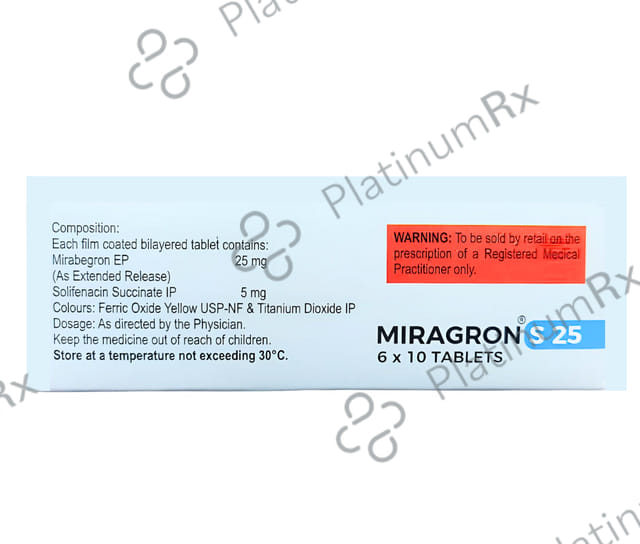






UrgeCure S 25/5mg Tablet ER 10s

UrgeCure S 25/5mg Tablet ER 10s is a prescription medicine that combines two bladder medicines, mirabegron and solifenacin (used as solifenacin succinate), for adults with overactive bladder (OAB). Overactive bladder causes sudden, strong urges to pass urine (urgency), needing to go many times a day (frequency), and sometimes leaking urine before reaching the toilet (urge incontinence). Mirabegron is a beta-3 adrenergic agonist (it switches on the bladder's "relax" signals) and solifenacin is a muscarinic antagonist (it blocks the bladder's "squeeze" signals), so each one relaxes the bladder muscle through a different route. Used together, UrgeCure S 25/5mg Tablet ER 10s aims to reduce urgency, frequency and leaks. It is taken once a day and only under a doctor's supervision.

Read more

Written by: Syed Jommy Abbas, B. Pharma

Reviewed by: Dr. Devika Rani, MBBS

Last updated on: 26-09-2026

Same Composition
Same Strength
FDA Approved
Same Composition
Currently Viewing
UrgeCure S 25/5mg Tablet ER 10s

Fringe Pharma

Strip of 10 tablets

See affordable match

Top Substitute
2.1K Bought this instead

Delivery by

...

FDA & GMP Certified

Long Expiry (>8 Months)

15 Days Easy Returns

Medicine Comparison

100% Exact Salt Match
UrgeCure S 25/5mg Tablet ER 10s
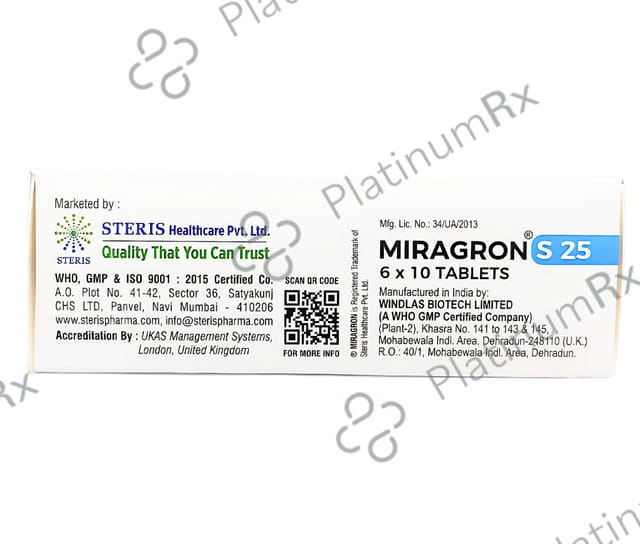
Miragron S 25/5mg ER Tablet 10s
FDA Approved
FDA Approved
₹40 / Unit
₹17.6 / Unit

Have a question?

Doctor Approved & Trusted
thumbnail

Genuine Medicine

Pay On Delivery

Secure Payment

LegitScript Certified

LegitScript Certified Online Pharmacy

More About UrgeCure S 25/5mg Tablet ER 10s

Detailed Description

UrgeCure S 25/5mg Tablet ER 10s is used to treat overactive bladder in adults who have urgency, frequent urination and urge leaks. The US prescribing information for mirabegron lists its use together with solifenacin succinate for exactly these symptoms.

Your bladder is a muscular bag. Its wall muscle is called the detrusor. When the bladder is overactive, this muscle squeezes at the wrong times, even when the bladder is not full. That gives you the sudden "I have to go now" feeling.

The two medicines in UrgeCure S 25/5mg Tablet ER 10s calm this muscle in two separate ways. Mirabegron switches on beta-3 receptors in the bladder wall, which helps the muscle relax while the bladder is filling, so it can hold more urine. Solifenacin blocks muscarinic receptors, which are the spots where the nerve messenger acetylcholine tells the bladder muscle to squeeze. One part helps the muscle relax, and the other reduces the signals that make it contract.

Both medicines stay in the body a long time. Mirabegron has a half-life of about 50 hours in adults, and solifenacin about 45 to 68 hours. This is why UrgeCure S 25/5mg Tablet ER 10s is taken only once a day. Mirabegron starts to act within a few hours, but it can take several weeks (the NHS says up to 4 to 8 weeks) before you notice a clear change in symptoms.

UrgeCure S 25/5mg Tablet ER 10s needs regular medical follow-up. Mirabegron can raise blood pressure, so the label advises periodic blood pressure checks, especially in people who already have high blood pressure (hypertension). Solifenacin can cause dry mouth, constipation and blurred vision, and rarely confusion or heart rhythm changes. Using both medicines together can also make it harder for some people to empty the bladder fully (urinary retention), particularly men with an enlarged prostate or anyone with a blocked bladder outlet.

Your doctor will check your kidney and liver health, your blood pressure and the other medicines you take before starting UrgeCure S 25/5mg Tablet ER 10s. Tell your doctor about any eye condition such as glaucoma, stomach emptying problems or heart rhythm problems.

Composition

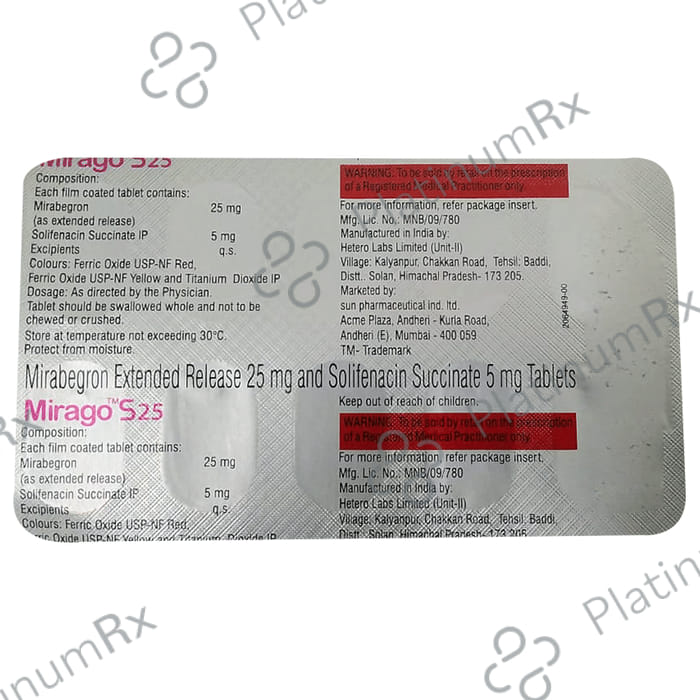
Each hard gelatin capsule of UrgeCure S 25/5mg Tablet ER 10s contains:

  • Mirabegron - 25 mg or 50 mg, as an extended-release (slow-release) tablet.
  • Solifenacin succinate - 5 mg, as an immediate-release (regular) tablet.

Uses of UrgeCure S 25/5mg Tablet ER 10s

Overactive bladder (OAB) in adults

UrgeCure S 25/5mg Tablet ER 10s is used to treat overactive bladder in adults who have these symptoms:

  • Urge urinary incontinence - leaking urine when a sudden urge to go comes on.
  • Urgency - a sudden, strong need to pass urine that is hard to put off.
  • Urinary frequency - needing to pass urine many times a day.

In India, the combination approved by the drug regulator (CDSCO) for overactive bladder comes as a hard capsule that holds a slow-release mirabegron tablet and a regular solifenacin succinate tablet, in strengths of 25 mg + 5 mg and 50 mg + 5 mg.

In large studies of adults with overactive bladder who had leaks, taking mirabegron together with solifenacin 5 mg led to greater improvement than either medicine alone, including in a study that lasted 12 months.

Benefits of UrgeCure S 25/5mg Tablet ER 10s

  1. Two ways of calming the bladder - Mirabegron relaxes the bladder muscle through beta-3 receptors, while solifenacin blocks the muscarinic signals that make the muscle squeeze. The two actions work side by side.
  2. Targets all three main OAB symptoms - UrgeCure S 25/5mg Tablet ER 10s is used for urgency, frequent urination and urge leaks in adults with overactive bladder.
  3. Once-a-day dosing - Both medicines last a long time in the body, so a single daily dose is enough. This makes it easier to fit into a daily routine.
  4. Flexible with meals - The labels for both medicines say they can be taken with or without food.
  5. Uses the lower solifenacin strength - In the US combination dosing, solifenacin stays at 5 mg. In solifenacin studies, dry mouth and constipation were reported less often at 5 mg than at 10 mg.
  6. Single fixed-dose combination - Both medicines are taken together in one once-daily dose. In India, the approved combination holds both in a single capsule.

Side Effects of UrgeCure S 25/5mg Tablet ER 10s

Common Side Effects (Usually Mild and may lessen with continued use)

In the 12-week combination studies described in the US label, dry mouth was the most frequent side effect, reported by about 7 to 9 in every 100 people.

  • Dry mouth
  • Constipation
  • Urinary tract infection (burning or stinging when passing urine, cloudy urine)
  • Headache
  • Faster heartbeat than usual (tachycardia)
  • Blurred vision
  • Dry eyes or dry skin
  • Dizziness
  • Stomach pain, upset stomach or heartburn
  • Back pain or joint pain

Serious Side Effects (Seek Urgent Medical Attention)

  • Angioedema and severe allergic reaction (anaphylaxis) - Swelling of the face, lips, tongue or throat, trouble breathing or swallowing, hives or a spreading rash. Swelling of the throat can block the airway and can be life-threatening. Get emergency help straight away; the labels advise that the medicine is stopped if this happens.
  • Urinary retention - Being unable to pass urine, a very weak stream, or a feeling that the bladder does not empty. This risk is higher when mirabegron and an antimuscarinic such as solifenacin are used together, and in people with a blocked bladder outlet.
  • QT prolongation and Torsade de Pointes - QT prolongation is a change in the heart's electrical rhythm that can be seen on an ECG (heart tracing). In some people it can lead to Torsade de Pointes, a dangerous, very fast and irregular heartbeat. These have been reported with solifenacin after it came on the market. Warning signs include a pounding or irregular heartbeat, fainting or feeling faint.
  • Irregular heartbeat (atrial fibrillation) - This has been reported with mirabegron after it came on the market. You may feel fluttering or racing in the chest.
  • Raised blood pressure - Mirabegron can increase blood pressure. Severe headache, chest pain or a very high home reading needs prompt attention.
  • Severe constipation or stomach pain - Constipation lasting more than 3 days, or severe belly pain, can mean the gut has slowed down too much.
  • Confusion, hallucinations or extreme sleepiness - Solifenacin can affect the brain, especially in older people. Seeing or hearing things that are not there needs urgent review.
  • Heat exhaustion or heat stroke - Solifenacin can reduce sweating, so the body may overheat in hot weather or during hard exercise. Signs include feeling very hot, weak, dizzy or confused without sweating much.

Directions for Use

  • Take UrgeCure S 25/5mg Tablet ER 10s once a day, at around the same time each day, exactly as your doctor has prescribed.
  • Swallow the tablet or capsule whole with a glass of plain water. Do not open, chew, crush or split it. The mirabegron label says not to chew, divide or crush mirabegron, because it is made to release slowly over the day.
  • You can take UrgeCure S 25/5mg Tablet ER 10s with or without food. Pick one habit (for example, always after breakfast) and stick to it so you remember each day.
  • Keep taking it every day even when you feel better. Improvement often builds slowly over several weeks, so an early lack of change does not mean the medicine is failing.
  • Do not stop taking UrgeCure S 25/5mg Tablet ER 10s or change the dose on your own. If side effects bother you, speak to your doctor first.
  • Keep all appointments for blood pressure checks and treatment reviews. The NHS notes that doctors usually review this type of bladder treatment every 6 to 12 months.

How it works

UrgeCure S 25/5mg Tablet ER 10s works on the detrusor, the muscle in the bladder wall that squeezes to push urine out. In overactive bladder, this muscle contracts too often and too early.

Mirabegron (beta-3 adrenergic agonist) The bladder wall has "relax" switches called beta-3 adrenergic receptors. An agonist is a medicine that switches a receptor on. Mirabegron switches on these beta-3 receptors, which relaxes the detrusor muscle during the filling stage. As a result, the bladder can hold more urine (greater bladder capacity) before it sends a strong urge to go.

Solifenacin (muscarinic antagonist) Nerves tell the bladder to squeeze by releasing a chemical messenger called acetylcholine. It acts on "squeeze" switches called muscarinic receptors, mainly the M2 and M3 types in the bladder. An antagonist is a medicine that blocks a receptor. Solifenacin blocks these muscarinic receptors, so the bladder muscle gets fewer "squeeze" signals and has fewer sudden contractions.

Working together One medicine turns up the "relax" signal and the other turns down the "squeeze" signal. Because they act through different receptors, using both targets overactive bladder from two directions. The same blocking action of solifenacin in other parts of the body explains side effects such as dry mouth, constipation and blurred vision.

How the body handles it Solifenacin is broken down mainly by a liver enzyme called CYP3A4. Mirabegron slows down another liver enzyme, CYP2D6, which is why it can raise the levels of some other medicines. Both medicines have long half-lives (about 50 hours for mirabegron and 45 to 68 hours for solifenacin), which supports once-daily use.

Safety Advice for UrgeCure S 25/5mg Tablet ER 10s

icon
Pregnancy
Limited information

Not usually recommended. There is not enough information in pregnant women to say whether either medicine is safe for the baby. In animal studies at high doses, mirabegron was linked to reversible bone changes and lower birth weight in the young, and solifenacin also showed effects on development. Neither label carries a boxed warning or a specific contraception requirement. Tell your doctor if you are pregnant, planning a pregnancy or become pregnant while taking UrgeCure S 25/5mg Tablet ER 10s.

icon
Breastfeeding
Limited information

Use only after talking to your doctor. It is not known whether either medicine passes into human breast milk; both were found in the milk of animals. If your doctor agrees you can breastfeed, watch your baby for poor feeding, constipation, vomiting, fewer wet nappies or unusual fussiness and report these.

icon
Alcohol
Limited information

Best avoided, especially in the first weeks. Solifenacin together with alcohol can make you feel very sleepy, and alcohol can also make urgency and night-time toilet trips worse.

icon
Driving
Limited information

Take care. UrgeCure S 25/5mg Tablet ER 10s can cause blurred vision, dizziness or sleepiness in some people. Do not drive, ride a bike or use machinery until you know how it affects you.

icon
Kidney
Limited information

Use with caution. In severe kidney disease, doctors keep both medicines at their lower strengths. Mirabegron is not recommended in kidney failure with very low kidney function or in people on dialysis.

icon
Liver
Limited information

Use with caution. In moderate liver disease, doctors keep both medicines at their lower strengths. Neither mirabegron nor solifenacin is recommended in severe liver disease.

icon
Children
Limited information

Not for children. UrgeCure S 25/5mg Tablet ER 10s is used for overactive bladder in adults only.

icon
Elderly patients
Limited information

Use with caution. Studies showed similar benefit and safety in people over 65, but solifenacin blood levels were about 20 to 25 percent higher in older people. The NHS notes a possible risk of confusion, and possibly worsening dementia, in older people taking solifenacin, so report any memory or thinking changes.

Quick Tips for UrgeCure S 25/5mg Tablet ER 10s

  • Swallow the tablet or capsule whole with plain water; do not open, chew, split or crush it.
  • Take it at the same time every day to keep a steady routine.
  • Sip water or suck sugar-free sweets if dry mouth bothers you.
  • Eat fibre-rich foods and drink enough fluids to help prevent constipation.
  • Cut down on bladder irritants such as tea, coffee, cola, fizzy drinks, artificial sweeteners and citrus juices, which can make urgency worse.
  • Keep cool in hot weather, as UrgeCure S 25/5mg Tablet ER 10s can reduce sweating.
  • Check your blood pressure regularly if your doctor asks you to.
  • Be patient: it can take several weeks to notice the full effect.
  • Carry an up-to-date list of your medicines, because UrgeCure S 25/5mg Tablet ER 10s interacts with some heart and mental health medicines.

Storage Advice

  • Store at room temperature, as printed on the pack. The US mirabegron label advises 20°C to 25°C (68°F to 77°F).
  • Keep the medicine in its original pack or container, tightly closed, to protect it from moisture.
  • Keep away from direct heat and damp places such as the bathroom.
  • Keep out of the sight and reach of children and pets.
  • Do not use the medicine after the expiry date printed on the pack.

Drug-Food Interaction

  • Meals - Food does not have a meaningful effect on how mirabegron is absorbed in adults, and solifenacin can be taken with or without food. You can eat normally while taking UrgeCure S 25/5mg Tablet ER 10s.
  • Grapefruit and grapefruit juice - Solifenacin is broken down by the liver enzyme CYP3A4. Talk to your doctor before having grapefruit or grapefruit juice, as advised in patient guidance for solifenacin.
  • Alcohol - Alcohol together with solifenacin can cause marked sleepiness, and alcohol can make urgency and frequency worse.
  • Caffeine, fizzy drinks, artificial sweeteners and citrus juices - These do not change how the medicine works, but the NHS notes they can irritate the bladder and make overactive bladder symptoms worse.

Interactions with Other Drugs

  • Some heart medicines (metoprolol, flecainide, propafenone) - Mirabegron slows the CYP2D6 enzyme, which can raise the levels of these medicines in the blood. Your doctor may need to monitor you or adjust their doses.
  • Some antidepressants and antipsychotics (desipramine, thioridazine) - These are also broken down by CYP2D6, so their levels may rise with mirabegron. Extra care is needed with medicines where the gap between a helpful and a harmful dose is small.
  • Digoxin (for heart failure or irregular heartbeat) - Levels of digoxin can rise. The mirabegron label advises using the lowest digoxin dose and checking digoxin blood levels.
  • Warfarin (blood thinner) - In studies, mirabegron caused only a small rise in warfarin levels and did not change clotting test results (INR). Tell your doctor if you take warfarin.
  • Strong CYP3A4 blockers (such as ketoconazole) - Ketoconazole raised solifenacin exposure about 2.7-fold in studies. The solifenacin label advises not going above 5 mg of solifenacin a day with these medicines.
  • Medicines that affect heart rhythm (QT-prolonging medicines) - Solifenacin is not recommended for people taking medicines known to prolong the QT interval, because of the risk of dangerous heart rhythms.
  • Other antimuscarinic medicines - Taking more bladder medicines or other anticholinergic medicines (medicines that block the same nerve signals, such as some allergy, stomach-cramp and older antidepressant medicines) on top of UrgeCure S 25/5mg Tablet ER 10s adds to the risk of urinary retention, dry mouth and constipation.

Always tell your doctor and pharmacist about every medicine, supplement and herbal product you use.

Drug-Disease Interactions

  • Urinary retention (unable to empty the bladder) - Solifenacin must not be used in people who already have urinary retention.
  • Blocked bladder outlet or enlarged prostate - Both medicines can make it harder to pass urine, so they are used with caution and you may be monitored for retention.
  • Gastric retention or slow gut movement - Solifenacin must not be used when the stomach does not empty properly, and it is not recommended when gut movement is already reduced, such as with severe constipation.
  • Uncontrolled narrow-angle glaucoma - Solifenacin must not be used in people who have this eye condition when it is not under control.
  • Severe uncontrolled high blood pressure - Mirabegron is not recommended when high blood pressure is severe and uncontrolled - a top reading of 180 or more, or a bottom reading of 110 or more (mm Hg). People with high blood pressure need regular checks.
  • Heart rhythm problems (history of QT prolongation) - Solifenacin is not recommended for people at high risk of QT prolongation.
  • Kidney disease - Severe kidney disease needs lower strengths; mirabegron is not recommended in very severe kidney failure or on dialysis.
  • Liver disease - Moderate liver disease needs lower strengths; neither medicine is recommended in severe liver disease.
  • Allergy - Anyone who has had an allergic reaction to mirabegron, solifenacin or any other ingredient in the medicine should not take UrgeCure S 25/5mg Tablet ER 10s.

Daily Dose

  • UrgeCure S 25/5mg Tablet ER 10s is taken once a day. The US prescribing information for combined use describes mirabegron 25 mg together with solifenacin succinate 5 mg once daily, and mirabegron may be raised to 50 mg (with solifenacin staying at 5 mg) if the doctor decides it is needed.
  • The label describes a maximum of mirabegron 50 mg with solifenacin 5 mg in 24 hours. Only one dose is taken in a day.
  • The US label describes the two medicines taken as separate products. The combination approved in India uses the same strengths, 25 mg + 5 mg and 50 mg + 5 mg, in one capsule.
  • People with severe kidney disease or moderate liver disease are usually kept on the lower mirabegron strength.
  • Your doctor chooses the strength that suits you. Always follow the dose on your prescription and never change it on your own.

Overdose

Taking too much UrgeCure S 25/5mg Tablet ER 10s can affect the heart and the brain.

Possible signs of overdose include:

  • Fast or pounding heartbeat (palpitations)
  • Flushing, fever or feeling very hot
  • Very dry mouth, eyes or skin
  • Blurred vision or widened pupils
  • Confusion, hallucinations or unusual behaviour
  • Shaking hands (tremor) or difficulty walking

What to do:

  • Go to the nearest hospital emergency department straight away, even if you feel fine.
  • Take the medicine pack with you so doctors know what was taken and how much.
  • Treatment in hospital is supportive, with close checks of pulse, blood pressure and heart rhythm (ECG).

What If You Forget to take UrgeCure S 25/5mg Tablet ER 10s?

  • If you miss a dose, skip the missed dose and take your next dose at your usual time the next day. This follows the advice given for solifenacin.
  • Never take two doses in the same day to make up for a missed one.
  • If you often forget, set a daily phone alarm or link the dose to a routine such as breakfast.
  • If you are unsure what to do after a missed dose, ask your pharmacist or doctor.

When to contact doctor

Get emergency help or contact your doctor straight away if you have:

  • Swelling of the face, lips, tongue or throat, or trouble breathing or swallowing
  • Hives, a spreading rash or severe itching
  • Being unable to pass urine, or a very weak stream with a full, uncomfortable bladder
  • Fainting, a racing, pounding or irregular heartbeat
  • A severe headache, chest pain or very high blood pressure readings
  • Constipation lasting more than 3 days, or severe stomach pain
  • Confusion, hallucinations or extreme sleepiness
  • Feeling very hot, dizzy or weak in hot weather without sweating much
  • Blurred vision that affects your daily activities
  • Pain or burning when passing urine, or fever, which may point to a urine infection

FAQ

Fact Box

Therapeutic Class

Urinary antispasmodic (overactive bladder medicine)

Action Class

Beta-3 adrenergic agonist (mirabegron) + muscarinic receptor antagonist (solifenacin)

Chemical Class

Aminothiazole acetanilide derivative (mirabegron) + quinuclidinyl tetrahydroisoquinoline carboxylate ester (solifenacin)

Habit Forming

No

Disclaimer

PlatinumRx is committed to providing reliable and accurate information to support informed customer decisions. However, all information made available on the Platform, including product descriptions, comparisons, and other content, is provided solely for general informational purposes. Such information is not intended to diagnose, prevent, treat, or cure any medical condition, nor should it be relied upon as a substitute for professional medical advice, diagnosis, or treatment.

View More
editorial-png
Authentic & trustworthy information
Having issues with the content?
Report Error

Customers also bought