Paracetamol Syrup for Childrens: Uses, Dose and Safety in India
Last Updated: September 29, 2026
Summary
Paracetamol syrup for kids is a liquid form of the painkiller and fever-reducing medicine paracetamol, given to children who cannot yet swallow tablets. It comes in several different strengths in India, so the same number of millilitres from two different bottles can contain very different amounts of medicine. It brings down fever and eases mild to moderate pain, but it does not treat the illness causing them.
Key Takeaways
- Dose by weight, not by age, whenever you know your child's weight. The usual single dose is 10–15 mg for every kilogram your child weighs.
- Wait at least 4 hours between doses, and never give more than 4 doses in 24 hours.
- Read the strength on your bottle before you measure. Children's paracetamol syrups sold in India include 120 mg/5 mL, 125 mg/5 mL, 240 mg/5 mL and 250 mg/5 mL, and infant drops can be 100 mg in each 1 mL.
- Use only the measuring cup or oral syringe that came with that bottle. A kitchen spoon is not accurate.
- If you think your child has been given too much, go to the nearest hospital emergency department straight away, even if your child seems perfectly well.
What Is Paracetamol Syrup for Children?
Paracetamol syrup is paracetamol mixed into a flavoured, sweet liquid base so that a child can swallow it easily. Paracetamol belongs to two groups of medicines — analgesics, which relieve pain, and antipyretics, which bring down fever. It is the only active ingredient in the syrup.
Paracetamol is not an anti-inflammatory medicine. It does not belong to the ibuprofen family, and it does not reduce swelling or redness the way those medicines do. Unlike ibuprofen, it does not irritate the lining of the stomach.
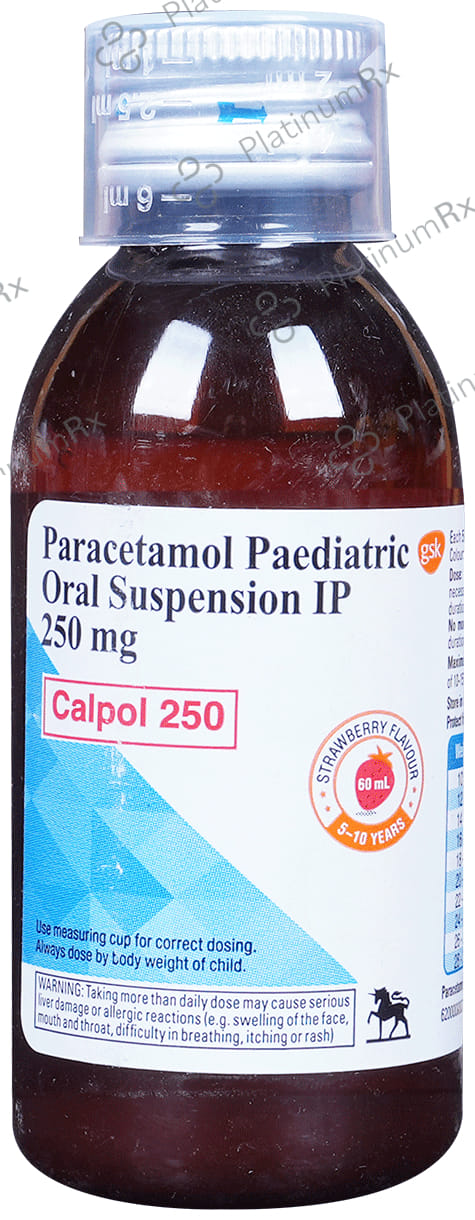
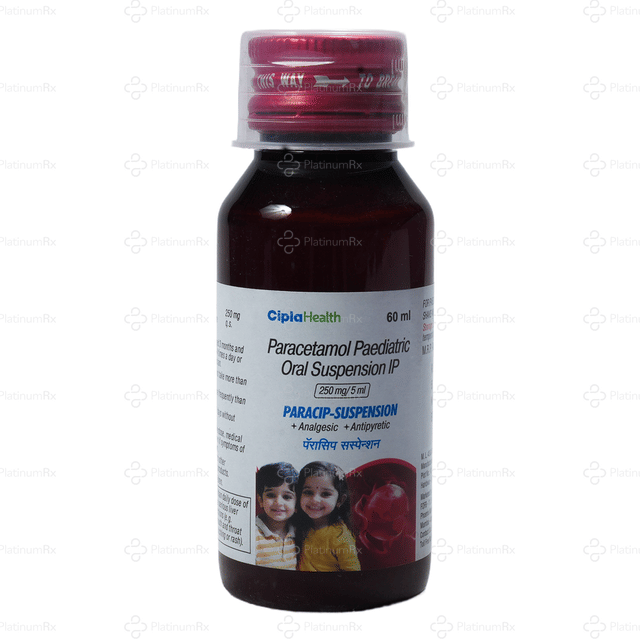
In India, a child's paracetamol syrup is not one fixed strength. Depending on the product, each 5 mL can contain 120 mg, 125 mg, 240 mg or 250 mg of paracetamol, and infant drops can hold 100 mg in a single millilitre. Bottles look similar and the labels are easy to mix up, so always read the strength printed on your own pack before you measure anything.
Prescription status in India. Paracetamol is not a prescription-only medicine in India. Paracetamol tablets appear on the Indian household-remedies list rather than among prescription drugs, and paracetamol is sold over the counter. Some children's paracetamol syrups are still printed with the line "to be sold by retail on the prescription of a registered medical practitioner only", so check your own bottle. Whichever pack you have, give it in the dose your doctor or pharmacist has advised.
How it works
Paracetamol works mainly in the brain and spinal cord, not on the sore or swollen part itself. It turns down the enzymes the body uses to make its pain signals and to raise body temperature, so your child feels the pain less and the fever comes down. Because it acts in the brain rather than on the inflamed tissue, it does not reduce swelling or redness.
What Paracetamol Syrup Is Used For
Paracetamol syrup is used for two things in children: bringing down a fever that is making the child uncomfortable, and relieving mild to moderate pain. Doctors and paediatricians commonly advise it for:
- Fever that is distressing the child or making them miserable
- Fever and soreness after a vaccination
- Teething pain and toothache
- Earache
- Headache and body ache
- Sore throat
- The aches and fever that come with a cold or flu
Sore throat is the one case that needs a doctor rather than home treatment. Do not give paracetamol for a sore throat that is severe, lasts more than 2 days, or comes with fever, headache, rash, nausea or vomiting - any of those needs to be checked by a doctor, because they can be signs of a more serious condition.
Fever on its own is a sign, not the illness. A mildly raised temperature in a child who is drinking, playing and sleeping normally usually does not need medicine. Paracetamol is for a child who is uncomfortable or distressed because of the fever, or for a child whose doctor has asked you to treat the fever.
It is worth knowing what this medicine cannot do:
- It does not clear the infection causing the fever, whether that infection is viral or bacterial.
- It is not an antibiotic and is no substitute for one.
- It will not settle a child who is unwell for some other reason.
How Much Paracetamol Syrup to Give Your Child
Give 10–15 mg of paracetamol for every kilogram your child weighs, as a single dose. Indian labels usually state a single dose of 15 mg/kg. This is why a child's weight matters more than their age — two children of the same age can differ by several kilograms.
Never give more than 4 doses in 24 hours, and keep the total for the day at or below 60 mg/kg. Four doses of 15 mg/kg come to exactly 60 mg/kg, so those two limits are really the same limit.
If you do not know your child's exact weight, use the age and weight chart printed on your own pack. The table below shows the usual volumes for two of the strengths sold in India.
- Age: 3–5 months; Strength on the bottle: 120 mg/5 mL; Volume for one dose: 2.5 mL; Paracetamol in that dose: 60 mg
- Age: 6–23 months; Strength on the bottle: 120 mg/5 mL; Volume for one dose: 5 mL; Paracetamol in that dose: 120 mg
- Age: 2–3 years; Strength on the bottle: 120 mg/5 mL; Volume for one dose: 7.5 mL; Paracetamol in that dose: 180 mg
- Age: 4–5 years; Strength on the bottle: 120 mg/5 mL; Volume for one dose: 10 mL; Paracetamol in that dose: 240 mg
- Age: 6–7 years; Strength on the bottle: 250 mg/5 mL; Volume for one dose: 5 mL; Paracetamol in that dose: 250 mg
- Age: 8–9 years; Strength on the bottle: 250 mg/5 mL; Volume for one dose: 7.5 mL; Paracetamol in that dose: 375 mg
- Age: 10–11 years; Strength on the bottle: 250 mg/5 mL; Volume for one dose: 10 mL; Paracetamol in that dose: 500 mg
- Age: 12–15 years; Strength on the bottle: 250 mg/5 mL; Volume for one dose: 10–15 mL; Paracetamol in that dose: 500–750 mg
Look at how the millilitres change when the strength changes. A 4-year-old and a 10-year-old are both given 10 mL, but one receives 240 mg and the other receives 500 mg.
The other two strengths sold in India fall into these same two groups:
- If your bottle says 125 mg/5 mL, use the 120 mg/5 mL rows. The two strengths are within a few milligrams of each other.
- If your bottle says 240 mg/5 mL, use the 250 mg/5 mL rows.
The double-strength syrups are twice as concentrated as the standard ones. Read a standard-strength row while holding a double-strength bottle and you will give about twice the intended dose, so work out which group your bottle belongs to before you use the table.
The chart is built on an average weight for each age band, and the weight rule is the more accurate one. If your child is at the lighter end of a band, use the smaller volume in that row rather than the larger one. If you know the weight, dose on weight and use the 60 mg/kg ceiling rather than the row. The 12–15 years row covers the widest range in the table: 10 mL suits a lighter 12-year-old and 15 mL a heavier 15-year-old, but a 12-year-old who weighs well under 40 kg should be dosed on weight, not on that row.
Babies need smaller, more carefully calculated doses. Children under 3 months old should only be given paracetamol on a doctor's advice. For babies aged 2 to 3 months, paracetamol is sometimes used but again only when a doctor has advised it. If your child is under 1 year old, ask your paediatrician for the exact volume rather than working it out from the age chart.
Which strength is your bottle?
This is the single most common way parents accidentally give too much. Check the front of the label for the strength and note whether it says "per 5 mL" or "per mL".
- Infant drops — 100 mg per 1 mL. These are the most concentrated form.
- Standard syrup — 120 mg or 125 mg per 5 mL
- Double-strength syrup — 240 mg or 250 mg per 5 mL
Never measure a dose of drops using the volume you would use for a syrup, or the other way round. Never switch the measuring device from one bottle to another, and never guess the strength because the label has worn off — if you cannot read the strength, do not use that bottle.
A 12 kg child falls in the 6–23 months row, which gives 5 mL of the standard syrup. If you know the weight, the weight rule is the one to use instead — and that is where the strength on the bottle matters most: 120–180 mg is about 5 to 7.5 mL from a 120 mg/5 mL bottle, but only about 2.4 to 3.6 mL from a 250 mg/5 mL bottle. The numbers printed on the label, not the size of the spoonful, decide the dose.
How to measure and give the dose
- Shake the bottle well for at least 10 seconds. The medicine settles on standing.
- Read the strength on the label and the volume you need.
- Use the measuring cup or the oral syringe that came with that bottle. Do not use a kitchen spoon, a tablespoon, or the cap.
- Draw or pour up to the mark and check the level at eye level, not from above.
- Sit your child upright and give the medicine slowly into the side of the cheek, in small sips, so that it is not spat out or coughed back.
- Write down or note the time you gave it. Keeping a simple record is the easiest way to avoid giving two doses too close together.
- Rinse the measure afterwards, close the bottle tightly and put it away out of your child's reach.
Paracetamol can be given with or without food, and there is no food your child needs to avoid while taking it. If your child refuses the syrup, ask your pharmacist for advice before mixing it into milk, juice or food, because a child who does not finish the drink will not receive the full dose.
How often it can be repeated, and for how long
A dose may be repeated every 4 to 6 hours if your child still needs it. Four hours is the shortest gap allowed.
Do not give paracetamol syrup for more than 2 days (48 hours) in a row without speaking to a doctor or pharmacist. Indian paracetamol suspensions carry a 48-hour limit, which is stricter than the 3-day limit used in the UK and the US — where the two differ, follow the 48-hour one. Paracetamol treats the symptom, not the cause, so a fever that keeps returning needs to be looked at rather than simply covered up. See a doctor if a fever lasts more than 3 days, if pain lasts more than 5 days, if your child develops new symptoms, or if they seem to be getting worse at any point.
If your child is prescribed paracetamol regularly and you miss a dose, give it as soon as you remember — but only if at least 4 hours have passed since the last dose. If the next dose is nearly due, skip the missed one and carry on with the normal schedule. Never give two doses together to catch up. Paracetamol is not a medicine that needs to be tapered or stopped gradually.
Who Should Not Be Given Paracetamol, and Who Needs Extra Care
Most children over 2 months old can be given paracetamol. Younger babies need a doctor's advice before you give it, and the rules for children under 1 year are set out in the dosage section above. It is not suitable for every child, though, so the two lists below are worth keeping separate in your mind.
Do not give paracetamol syrup if:
- Your child has ever had an allergic reaction to paracetamol or to any ingredient in the syrup
- Your child has severe liver disease
Ask a doctor or pharmacist first if your child:
- Has a liver or kidney condition
- Is very dehydrated, has been vomiting, or is not drinking
- Has a long-term condition such as diabetes, epilepsy, heart problems or raised pressure in the eye
- Is taking warfarin or another blood-thinning medicine
- Is taking any other medicine at all, including cough, cold and combination pain products
- Needs paracetamol for more than a few days
Children who are old enough to swallow tablets can be given paracetamol tablets instead of syrup once a doctor or pharmacist confirms the right strength for their age — 250 mg melt-in-the-mouth tablets are usually for children aged 6 and above, and 500 mg tablets for those aged 10 and above. Do not give a child an adult tablet on your own judgement, because a single adult tablet can be far more than a small child needs.
Side Effects and Serious Warning Signs
Paracetamol rarely causes problems in children when it is given at the correct dose. When problems do occur, they fall into two very different groups.
- Occasional nausea or stomach discomfort — Swelling of the face, lips, tongue or throat; raised itchy rash; difficulty breathing or swallowing
- Feeling a little unsettled — Yellowing of the skin or the whites of the eyes; nausea; dark urine; pale stools; pain in the upper belly
- A mild rash — Unexplained bruising or bleeding, nosebleeds, or unusual tiredness
- — — Reddening, blistering or peeling of the skin, or mouth ulcers
The serious reactions listed above are rare, but they need urgent attention. Stop the medicine and get medical help straight away if you see any of them.
Two of these are easy to miss. Jaundice, which is a sign of liver injury, is harder to spot on brown or black skin, so look at the whites of the eyes and the palms of the hands rather than the face. Bruising and nosebleeds can be mistaken for ordinary childhood knocks, but bruising that appears without any injury, or bleeding that will not stop, is not normal.
Paracetamol does not make children drowsy or affect their behaviour, and it is not addictive.
Paracetamol Overdose in Children: What to Do
Go to the nearest hospital emergency department immediately. Do not wait to see whether your child becomes unwell.
Paracetamol is safe at the correct dose and genuinely dangerous above it. A child who has been given too much often looks completely normal for the first several hours, and the liver damage that follows can be serious and can appear a day or more later. Quick medical attention matters even when there are no signs or symptoms at all.
An emergency in India: call 112, or 108 for an ambulance. Go to the nearest hospital emergency department, and carry the bottle, pack or leaflet with you along with any remaining medicine.
When you get there, tell the staff:
- How much paracetamol your child was given, and in what strength
- What time it was given, and whether it was an extra dose or a double dose
- Your child's weight and age
- Any other medicines your child has taken, including cough, cold or combination products
While you are waiting, do not give any more paracetamol and do not try to make your child vomit. Do not offer food or drink if your child is drowsy or vomiting.
Situations that count as too much include giving a dose less than 4 hours after the last one, going past the maximum number of doses allowed in a day, and giving more than one medicine without checking that only one of them contains paracetamol. If you are unsure whether a dose was too much, treat it as one and get your child checked. That is always the safer mistake to make.
Other Medicines and Paracetamol
Paracetamol interacts with relatively few medicines, but the ones that matter are worth knowing.
- Any other medicine containing paracetamol. Cough syrups, cold and flu remedies, and combination painkillers often contain it. Read the label of everything you give, and remember that paracetamol may also be written as "acetaminophen". Combination cough and cold products that contain paracetamol also contain other active ingredients. They must not be given to a child under 2 years old at all, and for children aged 2 to 11 they should be used only exactly as the label directs.
- Warfarin and similar blood thinners. Regular paracetamol can strengthen their effect, so this combination needs to be managed by a doctor.
- Metoclopramide and domperidone, used for vomiting, change how quickly paracetamol is absorbed.
- Flucloxacillin, an antibiotic, is used with caution alongside paracetamol.
- Some epilepsy medicines, such as carbamazepine, can raise the risk of liver problems with long-term paracetamol use.
- Cholestyramine reduces paracetamol absorption if it is taken within an hour of the dose.
Paracetamol and ibuprofen should not be given at the same moment. Alternating between them is sometimes advised, but only when a doctor or nurse has told you to do it and how to space them out — and it is easy to lose track, so write down each dose and the time.
Storing Paracetamol Syrup
- Store it at room temperature, below 25 °C, in a dry place away from heat and moisture. A bathroom cabinet is a poor choice because of the damp.
- Do not freeze the syrup or keep it in the refrigerator unless the label says so.
- Keep the cap tightly closed and the bottle upright.
- Keep it out of your child's sight and reach. These syrups are sweet, and a child who finds one may drink from the bottle.
- Check the expiry date before each illness. Discard an out-of-date bottle safely, and never use a bottle whose strength label you cannot read.
- Never pour leftover syrup into another bottle or a food container, and never relabel it.
FAQs About Paracetamol Syrup for Childrens
References