Etoshine MR Tablet: Uses for Joint Pain, Muscle Spasms & More
Last Updated: October 6, 2026
Key Takeaways
- It is meant for short-term use, not long-term pain control.
- Do not mix it with other NSAIDs such as ibuprofen or diclofenac.
- It can hide a fever, which is a sign of infection, so tell your doctor if you are being treated for one.
- Get emergency help for chest pain, black stools or a swollen face or throat.
What is Etoshine MR Tablet?
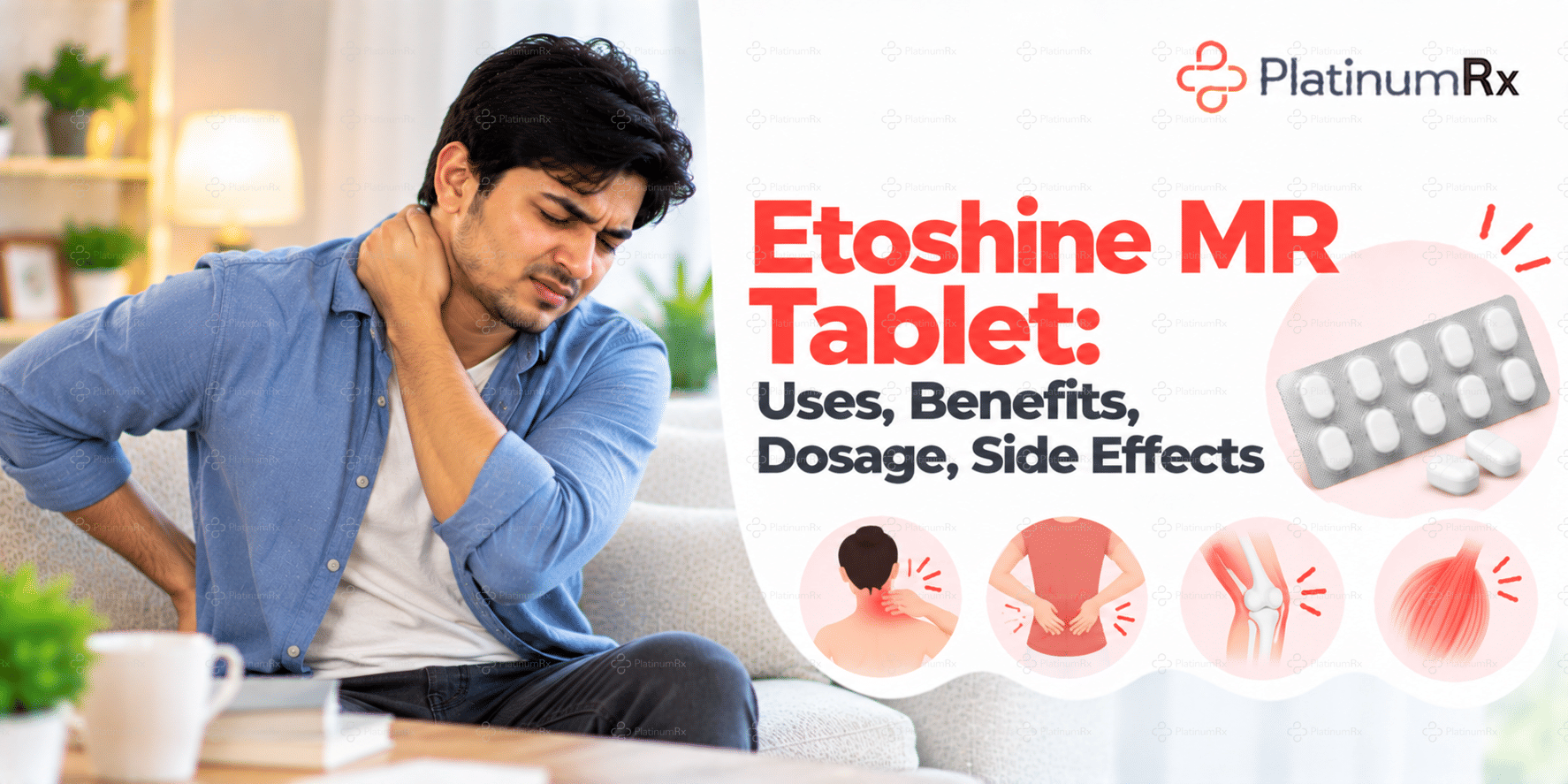
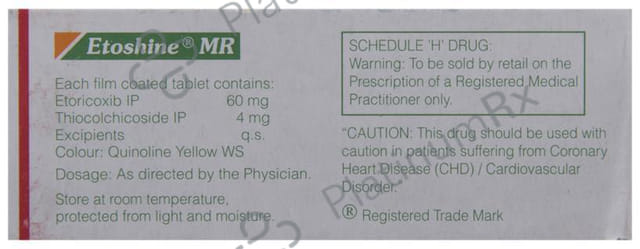
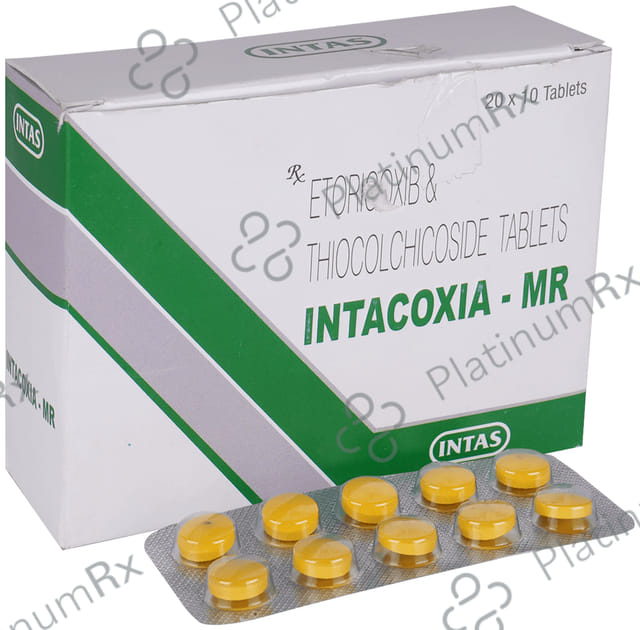
Etoshine MR is a fixed-dose combination tablet that contains two active ingredients, etoricoxib and thiocolchicoside. Etoricoxib belongs to a group of pain and swelling medicines called non-steroidal anti-inflammatory drugs, or NSAIDs. Thiocolchicoside is a muscle relaxant.
This tablet is prescription-only in India.
The same name is also sold as a single-ingredient tablet containing etoricoxib alone.
- Product: Etoshine MR Tablet; What it contains: Etoricoxib + thiocolchicoside; Strength available: 60 mg + 4 mg
- Product: Etoshine Tablet; What it contains: Etoricoxib only; Strength available: 60 mg, 90 mg, 120 mg
How Does Etoshine MR Work?
Etoricoxib is a COX-2 inhibitor. It blocks the COX-2 enzyme your body uses to make the chemicals of inflammation, which lowers the chemicals that cause pain and swelling.
Thiocolchicoside acts on receptors in the nervous system that control muscle function, helping tight, contracted muscles relax.
What is Etoshine MR Used For?
Etoshine MR is prescribed short-term for pain that comes together with muscle spasm.
- Painful muscle tightness in the back or neck, such as low back pain or neck pain with spasm
- Painful, stiff muscle sprains and strains
The position in India. Thiocolchicoside is a Schedule H prescription drug in India, so Etoshine MR cannot be bought without a doctor's prescription. In August 2024, CDSCO prohibited 156 fixed-dose combinations, including two containing thiocolchicoside — lornoxicam with thiocolchicoside, and a diclofenac with thiocolchicoside injection. Etoricoxib with thiocolchicoside is not on that list.
An EU restriction you should know about. In 2013, the European Medicines Agency restricted thiocolchicoside taken by mouth or injection. Its breakdown product, M2, was found to affect dividing cells at levels close to those reached at normal doses. That is a risk to a developing baby, a risk to male fertility, and a theoretical cancer risk with long-term use. So thiocolchicoside is now an add-on treatment only, for painful muscle contracture from spinal problems, in people aged 16 and over. The dose is capped at 8 mg twice a day, 12 hours apart, for no more than 7 days in a row by mouth. The agency also advised against use during puberty. This is a European restriction, not an Indian law, but it is why this is a short-course medicine.
Etoshine MR is not for coughs or infections. It does not treat the joint disease itself: etoricoxib on its own is used for osteoarthritis, rheumatoid arthritis and gout, but rheumatoid arthritis needs 90 mg a day and acute gout 120 mg a day, which this tablet does not provide, so those conditions need their own treatment. And it is not for long-term daily pain control.
Benefits of Etoshine MR
One tablet combines an anti-inflammatory painkiller with a muscle relaxant. That means it works on both parts of the problem your doctor is treating - the pain and swelling, and the tight, contracted muscle.
Dosage and How to Take Etoshine MR
Take Etoshine MR exactly as your doctor prescribes. Do not change the dose, add an extra tablet, or extend the course on your own.
The limits your prescription sits inside. Oral thiocolchicoside is capped at 8 mg twice a day, with the two doses 12 hours apart, and no more than 7 days in a row. Etoricoxib on its own is taken once a day, and the thiocolchicoside in this tablet sits inside that 8 mg cap. So how many tablets you take each day, and for how many days, is decided by your doctor within those limits.
- Swallow the tablet whole unless your doctor tells you otherwise.
- You can take it with or without food.
- Missed a dose: take it when you remember. If the next dose is nearly due, skip it. Never take two tablets to catch up.
- Took too much: go to the nearest hospital emergency department straight away and carry the strip or pack. In India, call 108 for an ambulance, or 112 for any emergency.
Do not use leftover tablets for a later episode of pain.
Who Should Not Take Etoshine MR
Do not take this medicine if any of these apply to you.
- Allergic to etoricoxib, thiocolchicoside or other NSAIDs
- Pregnant or breastfeeding, or a woman who could become pregnant and is not using contraception
- Under 16 years of age
- Active stomach ulcer or bleeding in the gut
- Heart failure, or uncontrolled blood pressure above 140/90 mmHg
- A heart attack, stroke or blocked leg arteries in the past
- Severe kidney or liver disease
- Inflammatory bowel disease such as ulcerative colitis or Crohn's disease
Who Needs to be Careful With Etoshine MR
Tell your doctor about these conditions before you start. They do not always stop you taking the tablet, but they change how closely you are watched.
- High blood pressure: it must be controlled before you start, and checked within two weeks of starting.
- Stomach problems or a past ulcer: NSAIDs can irritate the stomach lining and cause bleeding.
- Kidney or liver problems: your doctor may lower the dose or avoid this medicine.
- Asthma: some people with asthma react badly to NSAIDs.
- Diabetes, high cholesterol or smoking: these add to the heart and circulation risks.
- Older adults: side effects are more likely, especially stomach and kidney problems.
- Driving: if it makes you dizzy or drowsy, do not drive or use machines.
Pregnancy and breastfeeding. Do not take Etoshine MR at any stage of pregnancy or while breastfeeding, and it is not recommended if you are trying to conceive. Thiocolchicoside must not be used in pregnancy, and etoricoxib is not suitable either. If you could become pregnant, use contraception while taking it.
Side Effects of Etoshine MR
Most side effects are mild and settle when the course ends. Some are serious and need urgent care.
- Stomach pain, heartburn, indigestion - Chest pain, breathlessness, or swollen feet
- Nausea, vomiting, diarrhoea or constipation - Weakness on one side, slurred speech, sudden severe headache
- Headache, dizziness, drowsiness - Black, sticky, tar-like stools, or vomiting blood
- Raised blood pressure, swollen ankles, bruising - Swollen face, lips, tongue or throat, or trouble breathing
Also get urgent help for yellowing of the eyes or skin, dark urine, or a blistering rash.
Stop the tablet and get medical help at once for any serious effect.
Interactions
Some medicines do not mix safely with Etoshine MR.
- Other NSAIDs, such as ibuprofen, diclofenac or aspirin → more stomach, kidney and heart risk
- Blood thinners such as warfarin → a higher chance of bleeding
- Blood pressure medicines and water tablets (diuretics) → they may work less well, and kidney strain is more likely
- Methotrexate → your doctor may want to monitor you more closely; at higher doses of etoricoxib, methotrexate levels can rise
- Steroid tablets such as prednisolone → a higher risk of stomach ulcers
- Antidepressants of the SSRI type → a higher risk of stomach bleeding
- Ciclosporin or tacrolimus → a higher risk of kidney damage
Alcohol is best avoided, as it increases the chance of stomach irritation and bleeding.
Tell your doctor about every other medicine you take.
Storage
- Keep the tablets in the original blister strip inside the carton, in a cool, dry place away from sunlight and moisture.
- Keep out of the sight and reach of children.
- Do not use the tablets after the expiry date.
FAQs Etoshine MR Tablet