Corbis 2.5 Tablet: Uses, Benefits, Side Effects & More!
Last Updated: November 19, 2026

Written by:
Shaik Ashraf Ali, B.pharmacy
Reviewed by:
Dr. Sarabjeet Kaur, MBBSPublished date: 19-Nov-2026
Summary
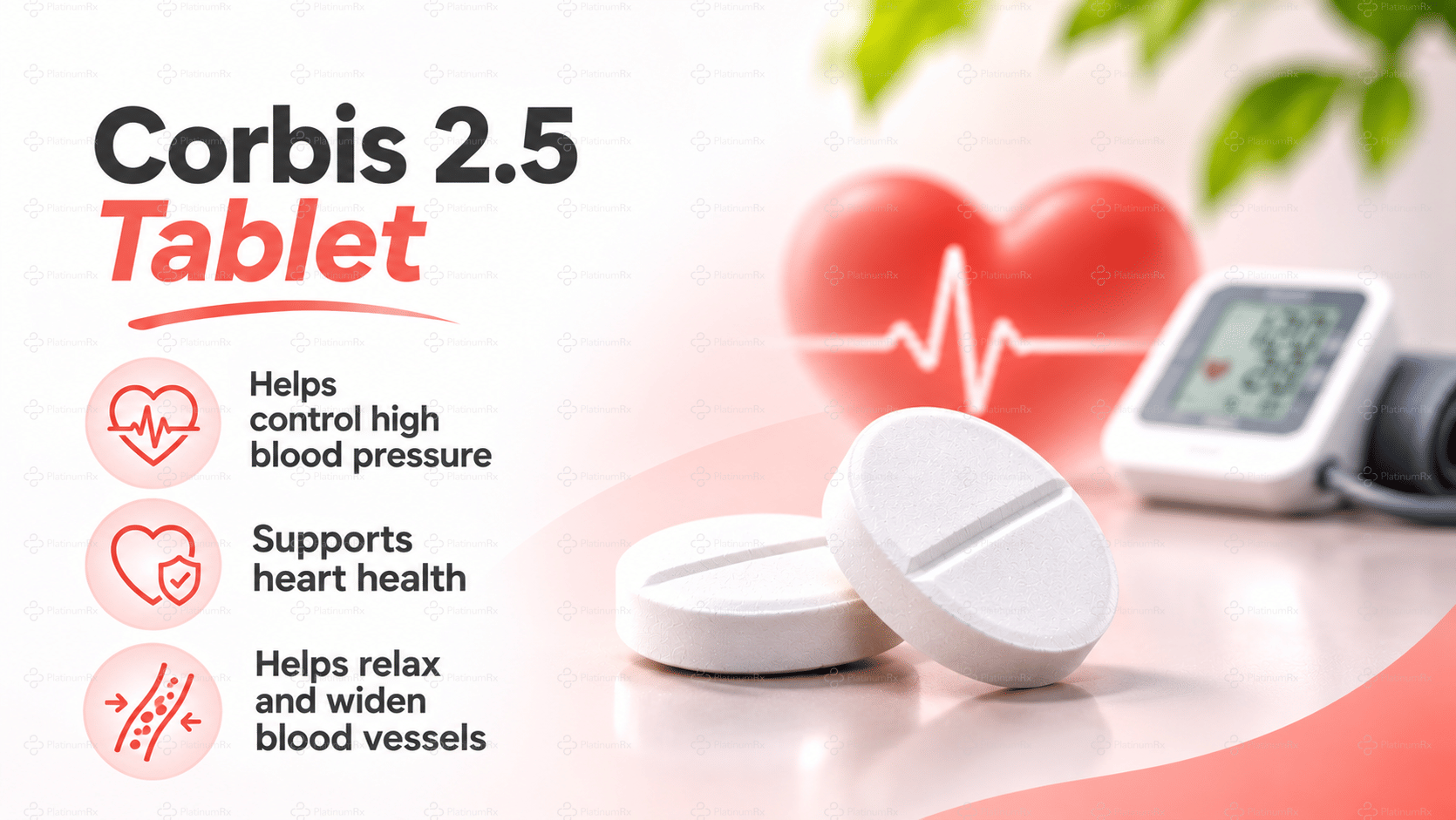
Corbis 2.5 is a film-coated tablet that lowers high blood pressure and makes the heart's work lighter. Doctors also prescribe it for angina - the chest pain that comes when the heart works harder - and for some people with heart failure. In India it is a prescription-only medicine, so take it only if a doctor has prescribed it. Its active ingredient is bisoprolol, which slows the heart.
Key Takeaways
- What it is: A beta blocker tablet that slows the heart and lowers blood pressure.
- Active ingredients: Bisoprolol fumarate 2.5 mg.
- Used for: High blood pressure, angina and stable heart failure.
- Not meant for: An angina attack happening now, or people with severe asthma.
- Prescription: Needed in India. Take it only on a valid prescription.
- How to take: Once daily in the morning, with water; you can take it with food.
- Common side effects: Headache, tiredness, dizziness and cold hands or feet.
What Is Corbis 2.5?
Corbis 2.5 is a tablet for high blood pressure and heart problems. It belongs to a group of medicines called beta blockers. The "2.5" is the strength: each tablet contains 2.5 mg of bisoprolol fumarate, and a strip holds 15 tablets.
Corbis 2.5 Composition (Per Tablet)
| Ingredient | Amount | Type | What it does (in simple words) |
|---|---|---|---|
| Bisoprolol fumarate I.P. | 2.5 mg | Beta blocker (beta-1 selective) | Slows the heart and lowers blood pressure |
Its inactive ingredients include titanium dioxide and Brilliant Blue Lake, which make it light blue. Corbis also comes as 1.25 mg and 5 mg tablets, which are not licensed for exactly the same uses. Check the strength on your strip and take only what your doctor prescribed. It is made by Torrent Pharmaceuticals Ltd.
How Does Corbis 2.5 Work?
Your body sends an adrenaline "speed up" signal to the heart, and bisoprolol blocks the receptors that pick it up. So the heart beats more slowly and with less force, and blood pressure falls. The heart also needs less oxygen, which is why angina pain comes less often.
Uses of Corbis 2.5
Doctors usually prescribe Corbis 2.5 for:
- High blood pressure, where the pressure inside your blood vessels stays at 140/90 mmHg or higher on two different days.
- Angina, chest pain or tightness that comes when the heart works harder, such as walking uphill.
- Preventing angina attacks, so the same effort is less likely to bring the pain back.
- Stable heart failure, where the heart cannot pump as well as it should. Here it is added to other heart medicines and started very low.
Corbis 2.5 does not treat an angina attack that has already started, and it does not open narrowed arteries. It is not a treatment for anxiety or an unchecked fast heartbeat.
Angina Attack vs Daily Angina Prevention: Is Corbis 2.5 Right for You?
| What to compare | Angina attack happening now | Preventing angina attacks |
|---|---|---|
| What it feels like | Chest pain or tightness, often spreading to the arm or jaw | No pain now; attacks come and go |
| Sign / sound / pattern | Set off by exercise, stress or cold; settles with rest | The same triggers set it off again and again |
| Is Corbis 2.5 suitable? | No | Yes, if prescribed for you |
| What usually helps | Rest, your angina medicine, and 112 if it does not settle | A daily beta blocker and your doctor's advice |
An extra tablet during an attack will not relieve it and can waste the minutes you need to get help.
How to Take Corbis 2.5 Tablet
- Take it at the same time each day, usually in the morning.
- Swallow it whole with water. Do not chew it.
- You can take it with food; the label says that is fine.
- The tablet has a break line; split it only if your doctor asks you to.
- Keep taking it on days when you feel well.
- Do not stop on your own; your doctor will lower the dose slowly.
Dosage of Corbis 2.5
Your doctor sets the dose. It depends on your age, kidney and liver function, why you need it, and how you respond. For high blood pressure, the label's usual adult dose is 10 mg once daily, up to 20 mg a day. Some people do well on 5 mg, and your doctor will say how many 2.5 mg tablets that means.
For stable heart failure, only your doctor decides when to move up; treatment starts low and is raised in steps, with a check-up each time. The steps are 1.25 mg daily for a week, then 2.5 mg, 3.75 mg, 5 mg, 7.5 mg and 10 mg daily long term. For the 1.25 mg and 3.75 mg steps your doctor may give you the 1.25 mg tablet, or ask you to break a 2.5 mg tablet in half. Never do this without being told to.
Never increase the dose on your own. It does not work faster, but it raises the risk of a slow pulse, dizziness and low blood pressure. In severe kidney or liver problems the dose should not go above 10 mg a day, and many older people do well on 5 mg. It is not recommended for children.
Too much can cause a very slow heartbeat, low blood pressure and low blood sugar. Go to the nearest emergency department at once with the pack.
What If You Miss a Dose?
Take the missed dose as soon as you remember, unless the next one is nearly due. If it is nearly time, skip it and carry on as usual. Never take two doses together to catch up.
How Long Does It Take to Work?
You may not feel any different at first, and it can take a few weeks to feel the full benefit. If your blood pressure or chest pain is not improving after a few weeks, go back to your doctor. Do not change the dose yourself.
Storage
Keep the strip in a cool, dry place, away from light, heat and moisture — not in the bathroom. Store it out of children's reach and do not use tablets after the expiry date.
Side Effects of Corbis 2.5
Most people take Corbis 2.5 without any trouble, and early effects usually settle.
Common and mild:
- Headache
- Feeling tired or weak
- Dizziness, especially when you stand up quickly
- Cold, numb or tingling hands and feet
- Feeling sick, vomiting, diarrhoea or constipation
- Vivid dreams, poor sleep or low mood
Rare but serious (stop the medicine and see a doctor right away):
- Wheezing or sudden difficulty breathing, especially with asthma
- Swelling of the face, lips or tongue, or a severe itchy rash
- A very slow or uneven heartbeat, or fainting
- New or worsening chest pain, or swelling in the legs
- Yellow eyes or skin, dark urine, or upper tummy pain
If you are told to stop, your doctor will lower the dose in steps - never stop it suddenly on your own.
Headache, dizziness and tiredness are most likely in the first days or after a dose increase. They often ease within one to two weeks.
If you feel very low, hopeless, or think about harming yourself, tell your doctor and call Tele-MANAS on 14416 (free, 24x7).
Who Should Not Take Corbis 2.5
- You are allergic to bisoprolol or to any ingredient in the tablet.
- You have severe asthma or another severe breathing problem.
- You have a very slow or uneven heartbeat, or heart block.
- You have very low blood pressure, shock, or heart failure that is worsening now.
- You have severely narrowed leg arteries, or severe Raynaud's.
- You have an untreated adrenal gland tumour or severe metabolic acidosis.
Severe Raynaud's means fingers that turn white, numb and painful in the cold.
Precautions
Tell your doctor before taking Corbis 2.5 if you have:
- Asthma or COPD, even if mild (it can tighten the airways).
- Diabetes (it can hide the signs of low blood sugar).
- Kidney or liver disease (the dose may need to be lower).
- Psoriasis, or an overactive thyroid (both can be hidden or made worse).
- Leg-artery narrowing or Raynaud's, even if mild (symptoms can get worse when you start).
- A pregnancy or plans for one (used only when clearly needed).
- You are breastfeeding (it is not recommended).
- You are over 65 (dizziness is more likely).
Tell your surgeon or dentist before any operation or dental treatment.
Drug Interactions
| Medicine | What can happen |
|---|---|
| Verapamil, diltiazem | Very slow pulse, low blood pressure and heart block |
| Flecainide, quinidine | Stronger effect on the heart's rhythm |
| Clonidine, methyldopa | Worsening heart failure; rebound high blood pressure if clonidine stops first |
| Amlodipine, felodipine | A bigger drop in blood pressure |
| Insulin, diabetes tablets | Low blood sugar is likelier and its signs may be hidden |
| Ibuprofen, diclofenac | Blood pressure may not come down as well |
| Timolol eye drops | Adds to the tablet's effect and can slow the pulse |
| Salbutamol inhalers | The inhaler may work less well |
Always tell your doctor about every medicine, supplement or home remedy you are using. Alcohol can drop your blood pressure further, so keep it to a minimum.
Frequently Asked Questions About Corbis 2.5
When to See a Doctor
Corbis 2.5 only controls the problem; it does not remove its cause. Get help quickly if you have:
- Chest pain that does not settle after resting, or comes with sweating or breathlessness — call 112.
- Fainting, or a pulse that feels much slower than usual.
- Sudden breathlessness, new wheezing, or worsening swelling in the legs.
- Swelling of the face, lips or tongue, or a severe rash.
- Yellow eyes or skin, dark urine, or upper tummy pain.
Call 108 for an ambulance if someone collapses or cannot be woken.
The Bottom Line
Corbis 2.5 is a once-a-day beta blocker that helps keep blood pressure, angina and stable heart failure under control. Do not take more than your doctor prescribed, even if your readings are still high. Headache, tiredness and dizziness are the usual early effects, and they mostly settle within a week or two.

Add PlatinumRx as a preferred source on Google