Cetirizine Syrup for Children: Uses, Benefits, How to Give
Last Updated: September 29, 2026

Key Takeaways
- Cetirizine syrup usually contains 5 mg of the medicine in 5 mL, and a small child often needs only 2.5 mL per dose.
- The amount and how often it is given depend on your child's age and on the prescription. Never guess the dose.
- It is an allergy medicine. It is not a treatment for a common cold, cough or fever.
What Is Cetirizine Syrup?
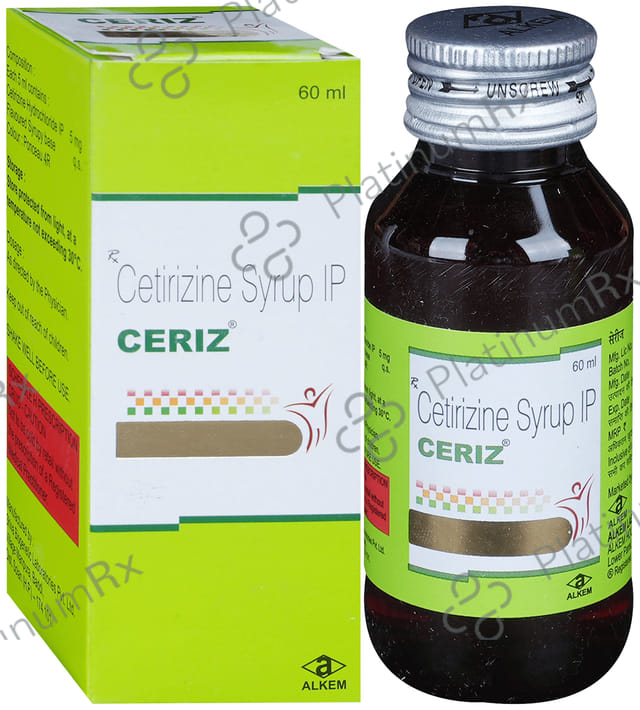
Cetirizine syrup is a liquid antihistamine medicine for children. In India, the syrup usually contains cetirizine hydrochloride 5 mg in every 5 mL, which is the same as 1 mg per mL. Cetirizine tablets are usually 10 mg, which is far more than a small child needs; some are 5 mg. Either way a tablet is not the right form for a small child.
One thing about its status in India is worth knowing:
- Cetirizine is listed in Schedule H of the Drugs and Cosmetics Rules. That makes it a prescription drug: it cannot legally be sold without a valid doctor's prescription.
Cetirizine is a human metabolite of an older antihistamine called hydroxyzine.
Buy Cetirizine Syrup for Childrens
What Cetirizine Syrup Is Used For
Cetirizine syrup is used to relieve allergy symptoms in children. Indian labelling approves it for two conditions.
Allergic rhinitis - allergy of the nose, often called hay fever. It eases:
- sneezing
- a runny nose
- itchy, watery eyes
- itching of the nose or throat
Chronic urticaria - hives that keep coming back without a clear cause. It eases the itching and reduces how bad the hives are and how long they last. It does not prevent hives from starting.
Your child gets a few practical benefits from this medicine:
- It causes much less drowsiness than the older antihistamines.
- It can be given with or without food.
- A syrup is easier to measure and easier for a small child to swallow than a tablet.
What Cetirizine Syrup Is Not For
- A common cold. No. Cetirizine is an allergy medicine, and a cold is caused by a virus rather than by histamine. Reviews of antihistamines for the common cold have found no evidence that they work in children. For a cold, offer fluids and saline nose drops, and use paracetamol, or ibuprofen if your child does not have asthma, for pain or fever. Children with asthma may not be able to take ibuprofen, so check with a pharmacist or doctor first. Children under 6 should not be given over-the-counter cough and cold remedies unless a doctor or pharmacist advises it.
- Fever or body ache. No. Cetirizine does not bring down fever and does not ease pain. Use whatever your doctor recommends for those symptoms.
- A severe allergic reaction (anaphylaxis). No. Cetirizine does not replace an adrenaline injection. If your child has a known severe allergy and has been given an auto-injector, use it as prescribed, then call 112 (or 108 for an ambulance) straight away. Never rely on cetirizine alone.
- Hives that are bruised, blistered, an unusual colour, or that do not itch. No. These need a doctor's assessment.
- A child under 2 years. Only if a doctor has decided it is needed.
How Cetirizine Works
Cetirizine blocks histamine H1 receptors. During an allergic reaction the body releases histamine. When histamine attaches to H1 receptors on blood vessels, nerve endings and immune cells, it causes swelling, itching, sneezing and a runny nose. Cetirizine occupies those receptor sites first, so histamine cannot attach and cannot set off those symptoms.
Cetirizine works mainly on H1 receptors outside the brain. That is why it causes far less drowsiness than the older antihistamines, which enter the brain more easily.
In adults and children, it usually starts working within about an hour, and one dose lasts about 24 hours.
At What Age Can a Child Take Cetirizine Syrup?
From 2 years of age, yes. Indian labelling approves cetirizine syrup for children aged 2 years and above, for allergic rhinitis and for hives.
In India the label does not cover children under 2. Cetirizine is given to a child that young only if a doctor has assessed the child and decided it is needed.
Two further age points matter:
- The tablet is not recommended for children under 6 years, because a tablet cannot be divided accurately enough for a small child's dose. Syrup is the right form for them.
- Labelling differs between countries. Some countries' labels allow cetirizine oral solution from 6 months of age for certain conditions, under medical supervision, and safety below 6 months has not been established. In India, follow the Indian pack insert and your doctor.
Cetirizine Syrup Dose for Children
Give exactly the amount your child's doctor has prescribed, measured with the cup or syringe that came with the bottle. The table below reports what the labels say. It is not a prescription for your child.
- Age group: 2 to under 6 years; Labelled schedule in India: 2.5 mg (2.5 mL) twice a day; Labelled schedule in the United States: 2.5 mg (2.5 mL) once a day; if needed, up to a maximum of 5 mg (5 mL) a day
- Age group: 6 to under 12 years; Labelled schedule in India: 5 mg (5 mL) twice a day; Labelled schedule in the United States: 5 mg (5 mL) or 10 mg (10 mL) once a day, depending on how bad the symptoms are
- Age group: 12 years and over; Labelled schedule in India: 10 mg (10 mL) once a day; Labelled schedule in the United States: Same advice as the row above; the US label treats all children aged 6 and over as one group
Follow the Indian column for your child. The US column is shown only to explain why pack instructions can look different abroad.
Points to keep in mind:
- Cetirizine syrup is usually 5 mg in 5 mL, so 2.5 mg is 2.5 mL, 5 mg is 5 mL and 10 mg is 10 mL.
- The labels set a ceiling of 5 mg (5 mL) in 24 hours for a child aged 2 to under 6 years, and 10 mg (10 mL) in 24 hours for a child aged 6 years and over.
- Children with kidney or liver problems need a different amount, decided by a doctor.
How to Give Cetirizine Syrup to Your Child
- Check the pack first. Confirm it is cetirizine syrup, read the strength on the label, and check the expiry date.
- Shake the bottle, then measure the dose into the cup or syringe that came with it. A kitchen spoon is not accurate enough.
- Give it at the same time each day, or as the prescription says. It can be given with or without food.
- If it is prescribed twice a day, leave about 12 hours between the two doses.
- Note down the time and the amount you gave, so that another caregiver does not give a second dose by mistake.
- Rinse the measuring cup and close the bottle tightly after use.
If a dose is missed, give it as soon as you remember. If it is almost time for the next dose, skip the missed one and carry on as usual. Never give a double dose to catch up.
A few cautions:
- Do not stop, restart or extend the course on your own. Ask the doctor.
- Before adding any other cough, cold or allergy syrup, ask the doctor or pharmacist. Some of these already contain an antihistamine, so the ingredients can add up.
Side Effects to Watch For
Most side effects are mild. In children, the more common ones are:
- drowsiness or sleepiness
- tiredness
- headache
- stomach pain
- diarrhoea
- dry mouth
- restlessness or irritability instead of drowsiness, in some children
- in children under 2 years: irritability, fussiness and trouble sleeping
Tell the doctor if any of these are severe or do not settle. While your child is drowsy, take care with play, cycling and, in teenagers, driving or operating machinery.
Some effects need medical attention:
- a rash
- difficulty breathing or swallowing
- swelling of the face, lips, tongue or throat
- intense itching that starts a few days after the medicine is stopped
In May 2025 the US FDA warned about this effect and asked manufacturers to add it to the labelling. It is most often reported after daily use for more than 3 months.
Rare but serious effects have also been reported:
- fits (convulsions)
- hallucinations, aggression or unusual behaviour
- a severe allergic reaction with breathing difficulty, wheezing, drooling, dizziness or fainting - treat this as an emergency
Who Should Not Take Cetirizine Syrup
These are absolute. The medicine must not be given to:
- A child who has ever had an allergic reaction to cetirizine, to hydroxyzine, to any piperazine-related medicine, or to any ingredient in the syrup.
- A child with severe kidney disease, where creatinine clearance is below 10 mL/min.
Who Needs Extra Care
These are relative. Tell the doctor before the medicine is given to a child who:
- is under 2 years old — only a doctor should decide
- has kidney problems — a child under 6 with kidney problems should not be given cetirizine at all. From 6 years up, the amount may need adjusting; your doctor will decide.
- has liver problems — a child under 6 with liver problems should not be given cetirizine at all. From 6 years up, the amount may need adjusting; your doctor will decide.
- has epilepsy or a risk of fits — cetirizine should be used with caution
- has a tendency to retain urine, for example because of a spinal cord problem, as cetirizine can add to that risk
- is taking sedatives or tranquilizers — these can increase drowsiness
- is due for allergy skin testing — antihistamines block the test, and a gap of at least 3 days is needed beforehand
One more point for mothers: cetirizine passes into breast milk, at levels between about a quarter and most of the level measured in blood. One labelling advises against using it while breastfeeding and another advises caution, so your doctor should decide. Questions about cetirizine in pregnancy belong to your own doctor, not to this article about your child.
Other Medicines, Food and Alcohol
Cetirizine can be given with or without food. Food slows down how quickly it is absorbed, but not how much is absorbed overall.
Few interactions of concern have been reported. At the usual doses, no clinically important interaction has been found with theophylline, azithromycin, pseudoephedrine, ketoconazole or erythromycin.
- Sedatives and tranquilizers can increase drowsiness. Tell the doctor if your child takes any.
- Alcohol adds to the drowsiness. This matters for teenagers, who should avoid alcohol while taking cetirizine.
- Do not add another antihistamine, or a cough-and-cold product, without asking first.
Overdose and What to Do
Treat an overdose as an emergency. In India, call 112 for emergency help or 108 for an ambulance, or go straight to the nearest hospital emergency department. Carry the bottle, pack or strip with you so the treating team knows exactly what was taken.
Symptoms reported after a large dose include drowsiness, restlessness, confusion, dizziness, tiredness, headache, a fast heartbeat, tremor, dilated pupils, difficulty passing urine and stupor. These have been reported after at least five times the recommended daily dose.
In one reported case, an 18-month-old who took about 180 mg became restless and irritable at first, and then drowsy.
There is no specific antidote for cetirizine. Hospital treatment is supportive. Cetirizine is not removed effectively by dialysis.
Storing Cetirizine Syrup
- Keep it in a well-closed container, protected from light, at a temperature not above 30°C. Check the pack, because products differ.
- Keep it out of the reach of children. Accidental overdose with antihistamine syrups is a real risk in small children.
- Check the expiry date, and do not use a bottle that has expired.
When to See a Doctor
Get emergency help straight away — call 112, or 108 for an ambulance — if your child:
- has trouble breathing or swallowing
- has swelling of the face, lips, tongue or throat
- has a fit (convulsion)
- is very drowsy or difficult to wake
- has a widespread rash together with dizziness, wheezing or fainting
- may have taken too much of the syrup
See the doctor soon if your child:
- is not improving on the prescribed amount
- has hives that do not improve within 3 days, or that last longer than 6 weeks
- becomes unusually restless, aggressive, or sees or hears things that are not there
FAQs
References